



Key Points
- Crawl Budget Preservation: Injecting a valid ISO 8601 date string prevents Googlebot’s Web Rendering Service from aggressively polling product URLs to verify price stability.
- Dynamic Fallback Implementation: Utilizing backend filters to programmatically append a rolling one-year validity date ensures continuous compliance without manual database manipulation.
- Headless Desynchronization: Custom GraphQL resolvers in decoupled architectures frequently fail to inherit backend schema filters, requiring dedicated frontend mapping for the Offer entity.
The Core Conflict: Understanding the priceValidUntil Ambiguity
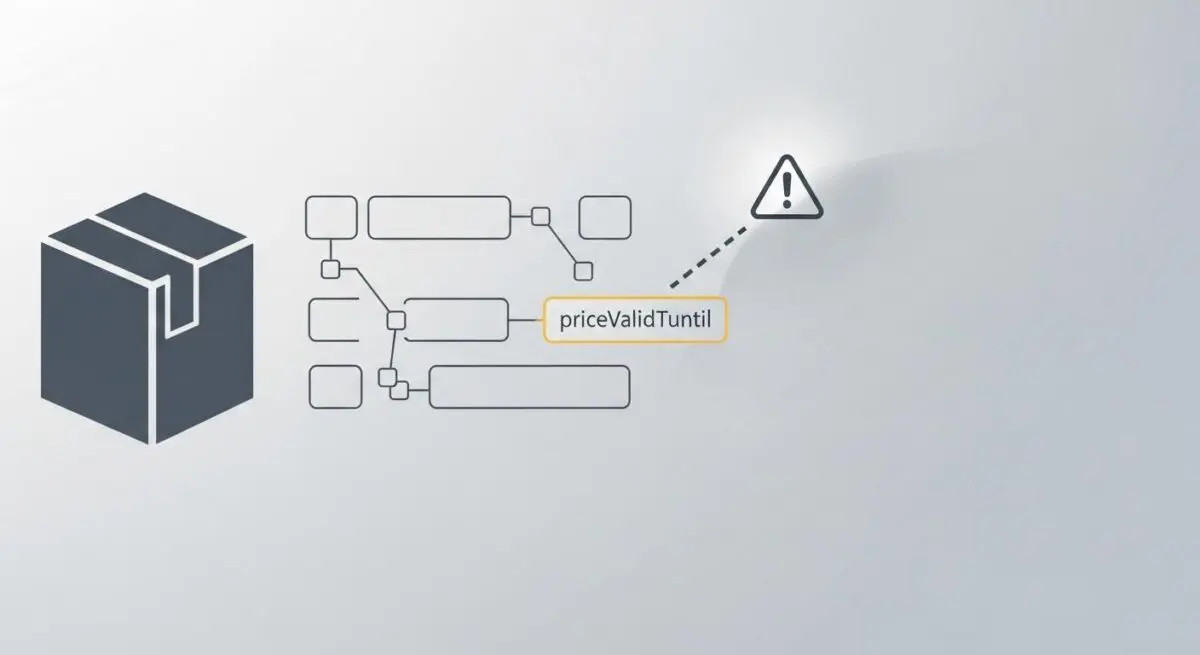
The missing priceValidUntil property in product structured data represents a critical breakdown in entity communication between an e-commerce server and search engine crawlers. This property requires an ISO 8601 formatted date string located within the Offer or AggregateOffer schema of a Product entity. It explicitly defines the temporal boundary after which a listed price is no longer guaranteed.
While historically treated as an optional enhancement for standard web snippets, it has escalated into a high-priority requirement for the Google Merchant Listings report. Its presence directly governs a product’s eligibility for Price Drop badges and inclusion in the highly competitive Google Shopping Tab.
From a technical architecture standpoint, omitting this field introduces a freshness ambiguity for Googlebot’s Web Rendering Service. Lacking a definitive validity boundary, crawlers are forced to increase their polling frequency for the specific URL to verify price consistency.
On large-scale e-commerce platforms, this aggressively consumes crawl budget, forcing the crawler to waste resources re-evaluating static pricing rather than discovering new product nodes. Furthermore, in the context of Generative Engine Optimization, LLM-based search agents heavily prioritize structured data with explicit expiration dates. This ensures they do not hallucinate stale pricing information to users, positioning the validity field as a critical trust signal for AI-driven commerce discovery.
When this architecture fails, the symptoms are immediately visible. The issue manifests in Google Search Console under the Merchant Listings report as a explicit warning indicating the missing field. Simultaneously, in raw server logs, engineers will notice frequent, redundant re-crawling of product pages by Googlebot-Image or Googlebot-Desktop as the engine attempts to validate price stability. Validation tools like the Schema Markup Validator or the Rich Results Test will display a yellow warning icon specifically within the Offer block of the JSON-LD payload.
Diagnostic Checkpoints: Identifying the Desynchronization
This error typically manifests as a desynchronization between the database layer, pricing calculation engines, and the final JSON-LD output. Identifying the exact point of failure within the application stack is required before applying a permanent patch.
Diagnostic Checkpoints
Undefined Sale End Dates
Missing sale end dates omit ‘priceValidUntil’ metadata.
Dynamic Pricing Engine Conflicts
Calculation plugins bypass structured data hook execution.
Legacy Theme Microdata Templates
Outdated itemprops lack modern schema property fields.
Most e-commerce platforms natively populate the validity field only when a specific sale end date is configured in the database. For instance, in WooCommerce, the system relies on the sale price dates meta field. If a product remains at its regular price, or is placed on a permanent sale without an end date, the backend logic returns a null value. This prompts the schema generator plugins, such as Yoast SEO or RankMath, to drop the key entirely rather than providing a logical fallback.
Additionally, server-side pricing plugins that calculate costs dynamically at runtime based on user roles, geolocation, or currency often fail to hook into the structured data filters. These plugins filter the standard price output methods to update the HTML DOM, but they bypass the structured data hooks, resulting in HTML price updates that do not reflect in the static JSON-LD payload. Finally, outdated themes utilizing inline microdata templates frequently lack the necessary markup architecture to support modern validity attributes, relying on hardcoded PHP templates that cannot support dynamic schema injection.
The Engineering Resolution: Remediation Steps
Resolving this schema deficiency requires intervening at the data compilation stage before the payload is serialized and served to the client. This ensures that the generated JSON-LD strictly adheres to the schema guidelines required by the Merchant Center.
Engineering Resolution Roadmap
Identify Schema Source and Format
Run the URL through the ‘Rich Results Test’. Determine if the schema is being injected via JSON-LD (Script tag) or Microdata (HTML attributes). If it is JSON-LD, identify the generator (e.g., ‘yoast-schema-graph’ or ‘rank-math-schema-data’) via the ID attribute in the script tag.
Inject Dynamic Fallback via Filter
Add a filter to the theme’s functions.php that checks for the existence of ‘priceValidUntil’. If missing, programmatically set it to the end of the current year or a +1 year rolling date to satisfy GSC requirements.
Database Batch Update (Optional)
For WooCommerce, use WP-CLI to identify products missing sale end dates and apply a bulk update to the ‘_sale_price_dates_to’ meta key if you prefer a database-level fix over a filter-level fix.
Purge Object and Edge Caches
Flush Redis/Memcached and purge the Cloudflare/Varnish cache to ensure the new LD+JSON block is served to Googlebot. Verify the X-Cache header shows a ‘MISS’ or ‘EXPIRED’ then ‘HIT’ on the subsequent request.
Applying a programmatic fallback is generally the most robust solution for extensive catalogs. By intercepting the schema array prior to serialization, developers can inject a rolling date string. This satisfies the validation requirements of the Merchant Center without requiring manual data entry for thousands of SKUs. Following any programmatic adjustment, cache invalidation across all layers is mandatory. Because JSON-LD is embedded within the HTML document, object caches like Redis may hold onto the old database query, while edge caches like Varnish or Cloudflare will continue to serve the stale HTML document to the Web Rendering Service.
Code Implementations: Patching the Data Layer
Fixing via WordPress and WooCommerce Filter
This implementation intercepts the WooCommerce structured data array. It verifies the presence of the validity key and injects a rolling one-year fallback if the value is empty. This code should be deployed within a custom functionality plugin or a child theme functions file.
/* Option 1: WordPress/WooCommerce (functions.php) - Injects a rolling 1-year fallback */
add_filter( 'woocommerce_structured_data_product_offer', 'fix_missing_price_valid_until', 10, 2 );
function fix_missing_price_valid_until( $offer, $product ) {
    if ( empty( $offer['priceValidUntil'] ) ) {
        $offer['priceValidUntil'] = date( 'Y-12-31', strtotime( '+1 year' ) );
    }
    return $offer;
}
Monitoring via NGINX Configuration
This custom log format tracks whether JSON-LD payloads are likely present by monitoring the response sizes of specific schema endpoints. This aids DevOps teams in identifying sudden drops in payload size which may indicate a schema generation failure at the server level.
/* Option 2: NGINX - Header addition for debugging (Checking for presence in log) */
# This is a log format to track if JSON-LD is likely present by monitoring response sizes of schema endpoints
log_format schema_debug '$remote_addr - $remote_user [$time_local] "$request" $status $body_bytes_sent';
Database Batch Update via WP-CLI
For administrators preferring a persistent database modification over runtime filtering, this command-line execution identifies products missing the specific meta field and applies a bulk update directly to the database layer.
/* Option 3: WP-CLI - Bulk update products missing the meta field */
# wp post list --post_type=product --format=ids | xargs -I % wp post meta update % _sale_price_dates_to '2025-12-31'
Validation Protocol and Edge Cases
Once the patch is deployed, immediate verification is required to confirm the payload integrity across all serving layers before the next crawler pass.
Validation Protocol
- GSC Live Test: Use URL Inspection to confirm ‘Merchant Listings’ warnings have vanished.
- Rich Result Test: Ensure ‘Offer’ object contains a valid ‘priceValidUntil’ field.
- CLI Verification: Run curl and grep to confirm correct string in raw HTML.
- DevTools: Inspect Network tab response body for the updated ‘ld+json’ block.
Standard remediation may fail in specific edge case scenarios. In Headless architectures utilizing frameworks like Next.js, a desynchronization can occur where the WordPress REST API excludes the validity field because it remains empty in the database. Even if a backend PHP filter is applied, custom GraphQL resolvers that do not account for this specific filter will fail to pass the modified data to the frontend rendering engine. This results in the field remaining missing on the rendered frontend despite being technically fixed in the backend.
Another severe edge case involves aggressive Cloudflare Edge Workers. If HTML minification regex rules are configured too broadly, they may strip the quotation marks from the ISO date strings during the edge processing phase. This instantly invalidates the JSON payload, causing the entire structured data block to be rejected by the search engine parser.
Autonomous Monitoring and Prevention
Preventing schema regressions requires shifting from reactive troubleshooting to proactive pipeline monitoring. Implementing a dedicated schema monitoring pipeline utilizing custom Python scripts and the extruct library allows engineering teams to crawl the site weekly. These scripts can automatically parse the DOM, extract the JSON-LD, and flag missing recommended fields before they impact Search Console metrics. Furthermore, integrating a schema validation step within the CI/CD process using libraries like schema-dts ensures that new code deployments or theme updates do not inadvertently drop critical attributes during the build phase.
For enterprise environments, relying on manual validation through web interfaces is unsustainable. At Andres SEO Expert, we advocate for deploying advanced automation pipelines that continuously monitor entity integrity. By leveraging server log analysis and custom API alerts, technical teams can maintain strict control over their structured data architecture. This proactive stance ensures continuous compliance with evolving search engine requirements and safeguards the domain’s representation within AI-driven knowledge graphs.
Conclusion
Resolving the missing validity property is not merely a compliance exercise; it is a critical optimization for crawl efficiency and AI-driven search visibility. By understanding the underlying data flow, identifying the point of desynchronization, and applying robust server-side filters, technical teams can permanently eliminate this ambiguity and restore precise entity communication.
Navigating the intersection of technical SEO, server architecture, and generative search requires a precise roadmap. If you need to future-proof your enterprise stack, resolve deep-level crawl anomalies, or implement AI-driven SEO automation, connect with Andres at Andres SEO Expert.