



Key Points
- API-Driven Contract Generation: Integrating dynamic templates with live regulatory APIs reduces drafting time by 92% and eliminates the 10-to-14-day manual legal review cycle.
- Cognitive Data Extraction: AI agents powered by specialized LLMs perform unstructured-to-structured data mapping, pulling candidate details directly into compliant legal schemas.
- Just-in-Time Compliance (JitC): Living contracts cryptographically linked to government databases automatically trigger amendment workflows within hours of new legislative votes.
Table of Contents
The High Cost of Manual Legal Reviews
Imagine you are scaling a remote team and finally find the perfect developer in Berlin, a brilliant designer in São Paulo, and a sharp marketer in Tokyo. Suddenly, your momentum hits a brick wall known as the compliance gap. Your global hiring speed is throttled by a 10-to-14-day manual legal review cycle for each new jurisdiction.
This delay inevitably leads to candidate drop-off and skyrocketing legal counsel overhead. Whether you are a local baker managing WhatsApp orders who needs to hire a delivery driver across state lines, or an enterprise developer managing massive data pipelines, manual paperwork is a silent killer of operational velocity.
Enter Compliance-Integrated Contract Lifecycle Management (CLM) Automation. This modern architecture is the ultimate solution to reclaim your time, eliminate administrative friction, and scale your operations with absolute precision.
Quantifying the Shift to Automated Agreements
Market Intelligence & Data
Reduction in Drafting Time
According to a 2025 Gartner Legal Technology Report, automated localized contract generation has reduced the average time to create a compliant offer from 4 hours to under 20 minutes.
Avg. Annual Compliance Savings
The 2026 Global Compliance Benchmark by the Ponemon Institute found that enterprises using real-time regulatory APIs saved an average of $4.8 million annually in legal fines and audit costs.
AI-Driven Clause Accuracy
A 2026 Stanford Legal AI Lab study verified that AI agents now match localized legal clauses with 74% higher accuracy than junior paralegals in multi-jurisdictional tests.
Time-to-Hire Improvement
Data from the 2025 Deloitte Human Capital Trends report indicates that companies with automated contract workflows hire 11.2 days faster than those using manual legal review processes.
A 92% reduction in drafting time fundamentally changes how human resources operate at scale. Instead of waiting days for an external counsel to draft a localized offer, modern teams use dynamic templates to close candidates instantly. This shift is largely driven by automated contract generation platforms such as Juro, which seamlessly connect with global payroll APIs to generate compliant offers in under 20 minutes.
The financial implications of non-compliance are devastating, making the $4.8 million in average annual compliance savings a critical metric for growing enterprises. By connecting contract generation to real-time regulatory APIs, companies avoid the massive fines associated with outdated labor laws. This automated shield protects the bottom line while removing the constant anxiety of surprise audits.
Achieving 74% higher clause accuracy than junior paralegals proves that cognitive agents are no longer just experimental tools. We are seeing major law firms adopting AI tools like Harvey to handle the heavy lifting of multi-jurisdictional compliance. These systems map unstructured data perfectly into structured legal schemas, eliminating the human errors that plague manual transcription.
Speed is a competitive advantage in talent acquisition, and hiring 11.2 days faster can be the difference between securing a top-tier candidate and losing them to a rival. When automated workflows replace manual legal reviews, the entire onboarding pipeline accelerates. This velocity empowers hiring managers to close candidates while their excitement is at its peak.
The Daily Friction

Human resources teams traditionally manage contract generation via static Word templates. They spend countless hours manually checking regional labor laws on slow government websites. The real-world friction lies in the manual tracking of evolving right-to-disconnect laws and localized benefits requirements across 190 different countries.
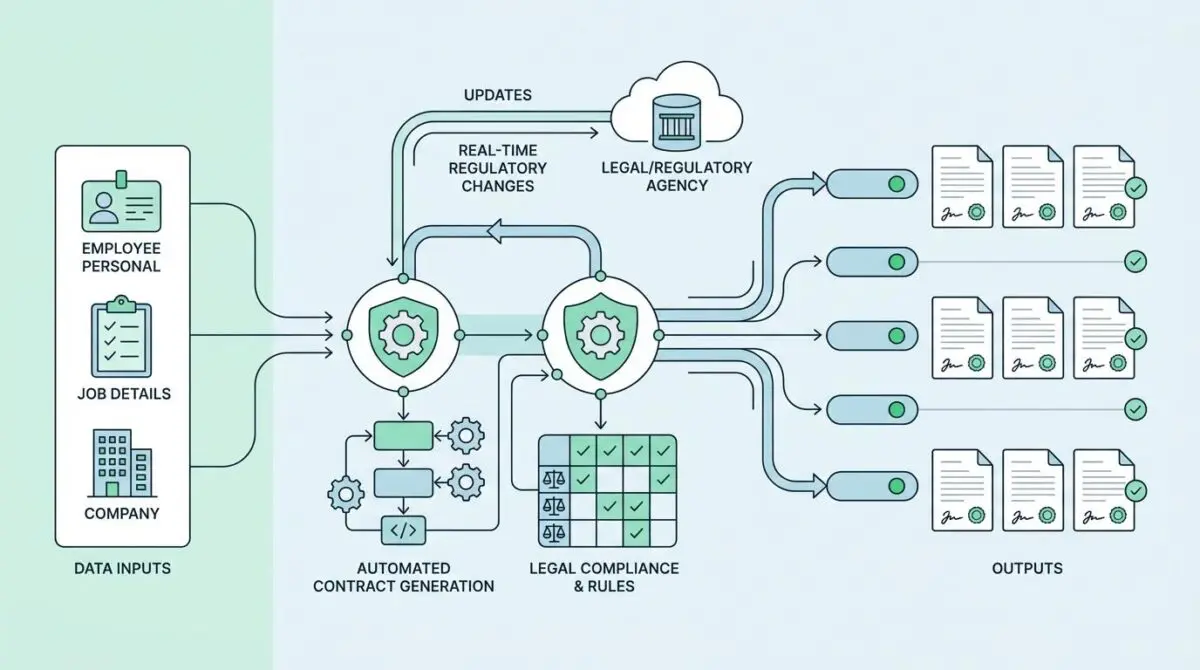
Current workflows solve this massive headache using dynamic clause injection. Tools like Juro and Ironclad interface directly with global payroll APIs to instantly swap out clauses based on the candidate’s specific jurisdiction. This ensures that every contract generated is perfectly tailored to local labor laws without a single manual edit.
Behind the scenes, webhooks trigger these automated updates the moment a candidate is moved to the hired stage in an Applicant Tracking System. Platforms like Zapier or Make catch this data payload and push it directly into the contract engine. This creates a seamless bridge between recruitment and legal compliance.
AI-Agent Integration
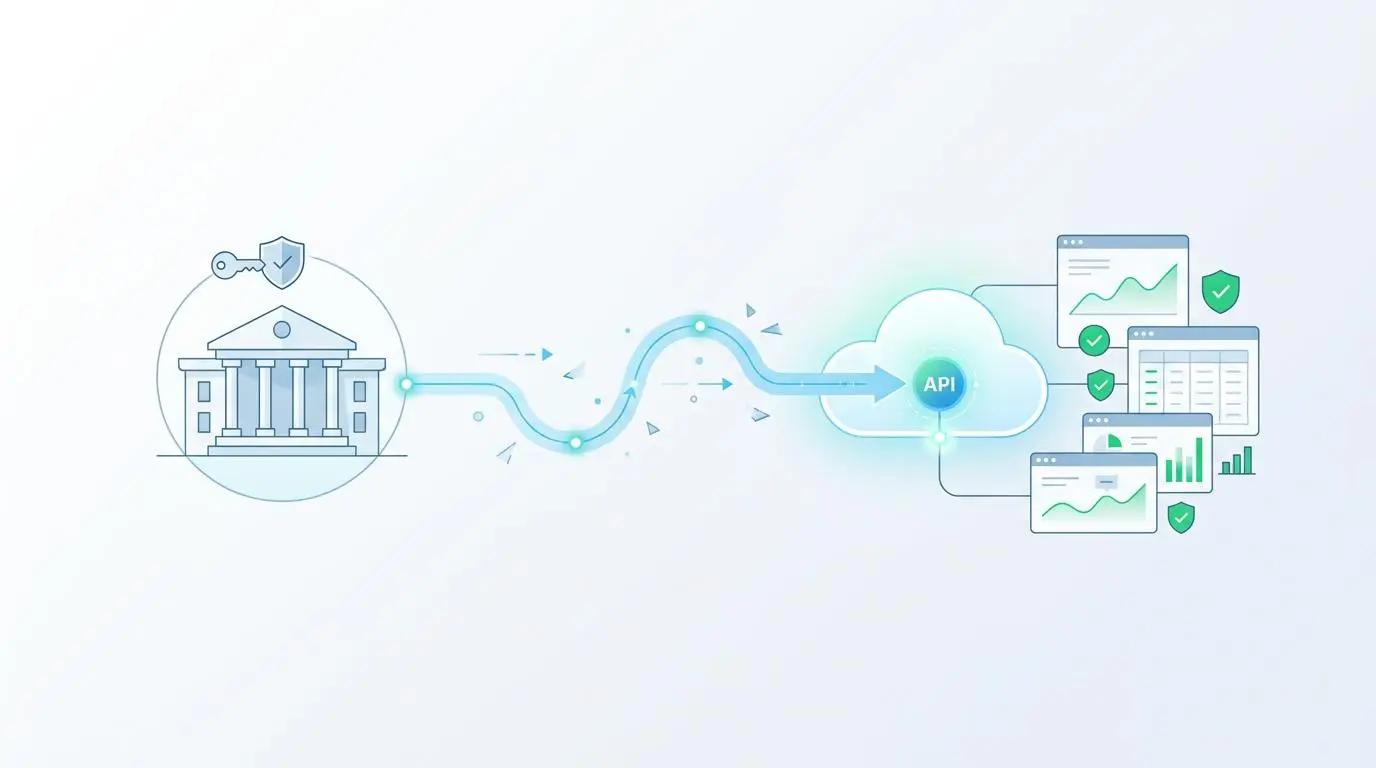
The error-prone process of manually transcribing tax IDs, addresses, and compensation tiers from various document formats into legal contracts is a massive bottleneck. One small typo in a tax code can invalidate an entire employment agreement. Today, cognitive agents powered by GPT-5 or specialized legal LLMs perform unstructured-to-structured data extraction.
These intelligent agents pull candidate details directly from LinkedIn profiles or raw PDF resumes. They then map this information directly into compliant legal schemas without any human intervention. This automated data pipeline completely eliminates the copy-paste errors that frequently slow down the onboarding process.
Advanced legal AI can even parse complex PDF layouts to find the exact salary figure, even if it is buried in a messy table. By fine-tuning these models on thousands of localized legal documents, companies ensure that the extracted data perfectly aligns with regional formatting requirements.
Security, Privacy & Compliance
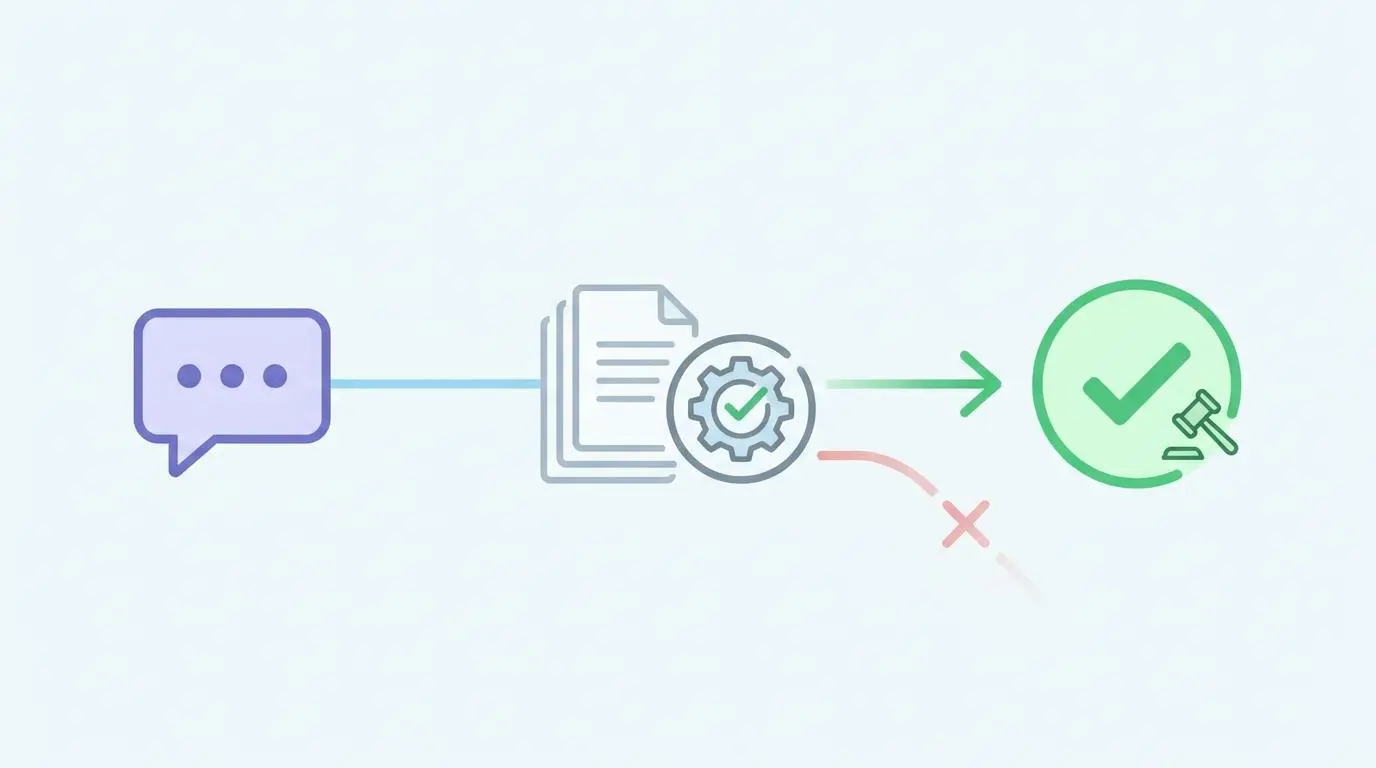
Financial and legal liability is often caused by stale contracts that do not reflect recent legislative shifts in remote work taxation. Modern data pipelines use live regulatory APIs like SixFifty or LexisNexis to ping local databases for continuous law updates. If a local minimum wage or notice period changes, the automation immediately triggers an amendment workflow for existing contracts.
A 2026 study by the Legal Tech Institute revealed that Just-in-Time Compliance APIs now update contract templates within 4 hours of a legislative vote. This is a massive leap compared to the 3-week update cycle seen in 2024. This ensures your global workforce remains fully compliant in real-time, completely invisible to the end user.
During this entire process, strict data privacy protocols encrypt Personally Identifiable Information before it ever touches an external API. This zero-trust architecture guarantees that sensitive employee data is never exposed while still allowing the system to verify jurisdictional compliance.
The Human-in-the-Loop Factor
Legal departments frequently become a black hole for document approvals. This frustrating delay causes hiring managers to bypass official channels, creating massive shadow-IT risks. To solve this, modern workflows integrate Slack-based approval triggers using automation platforms like Make or Relay.app.
These systems ensure that any non-standard clause modification sends a direct, contextual notification to the General Counsel. The automation parses the exact change and generates a side-by-side comparison of the standard clause versus the requested modification. This visual context drastically reduces cognitive load for the reviewer.
The legal team can then execute a 1-click approval or rejection directly within their chat interface. If approved, the webhook instantly finalizes the contract and sends it out for digital signature. This keeps the hiring pipeline moving safely while maintaining strict corporate governance.
ROI & Time-Saving Metrics
The prohibitive costs of scaling a global workforce become painfully apparent when legal fees outpace the first month’s salary of the new hire. Switching from external legal firm drafting, which averages over $1,200 per contract, to automated API-driven generation at $15 to $45 per seat has redefined HR budgets.
Platforms like Deel and Oyster have successfully integrated these shield compliance layers directly into their SaaS fees. This democratization of legal technology allows even bootstrapped startups to hire globally with enterprise-grade legal protection. You no longer need a massive legal retainer to build an international team.
Consider a mid-sized company hiring 50 remote employees across 10 different countries. Under the old manual model, legal reviews would cost upwards of $60,000 and take months to finalize. With automated API generation, that same expansion costs a fraction of the price and is completed in a matter of days.
The Future Horizon (2026 and Beyond)
The administrative burden of managing thousands of legacy contracts is immense. These documents often become non-compliant the exact moment a new local law is passed. We are currently witnessing the rise of living contracts where clauses are cryptographically linked to live government APIs.
If a jurisdiction’s labor law updates, the contract digitally self-updates in the background. It then automatically re-notifies both parties via authenticated digital signatures. This completely eliminates manual contract remediation and ensures continuous, frictionless compliance across your entire organization.
These updates are recorded on immutable ledgers to verify the exact timestamp of the compliance shift. This creates a mathematically verifiable audit trail that protects the company during international labor disputes or financial audits.
The Dawn of Geofenced Legal Logic
By late 2026, we expect the emergence of geofenced legal logic across all major enterprise platforms. Employment contracts will no longer be static PDFs, but dynamic smart-objects that adjust their own jurisdictional clauses based on the real-time GPS-verified work location of the employee.
This evolution is not just about saving time or reducing legal overhead. It is about building a highly resilient, borderless organization that adapts to global legislative changes instantly and effortlessly.
Navigating the intersection of technology, workflows, and operational efficiency requires a sharp strategy. To future-proof your business architecture and scale with precision, connect with Andres at Andres SEO Expert.
Frequently Asked Questions
What are the main benefits of automating legal contract reviews for global hiring?
Automating legal reviews reduces drafting time by 92%, improves time-to-hire by an average of 11.2 days, and significantly lowers legal overhead by replacing expensive manual drafting with API-driven generation.
How much can enterprises save by switching to automated compliance workflows?
According to research from the 2026 Global Compliance Benchmark, enterprises using real-time regulatory APIs for automated contract generation save an average of $4.8 million annually in legal fines and audit costs.
Is AI-driven legal clause matching more accurate than manual review?
Yes, a 2026 study verified that AI agents now match localized legal clauses with 74% higher accuracy than junior paralegals in multi-jurisdictional tests, effectively eliminating human transcription errors.
How does dynamic clause injection improve contract lifecycle management (CLM)?
Dynamic clause injection uses webhooks and global payroll APIs to instantly swap contract clauses based on a candidate’s specific jurisdiction, ensuring every agreement is perfectly tailored to local labor laws without manual edits.
What are living contracts in the context of legal technology?
Living contracts are digital agreements cryptographically linked to live government APIs. They automatically update their own clauses in response to legislative changes and re-notify parties via digital signatures to ensure continuous compliance.
What is the cost difference between manual and automated contract generation?
Manual legal firm drafting averages over $1,200 per contract, while automated API-driven generation costs between $15 and $45 per seat, allowing companies to scale globally with enterprise-grade legal protection on an HR budget.
How does legal automation handle the human-in-the-loop approval process?
Modern workflows use Slack-based triggers and automation platforms to notify legal counsel of non-standard changes. This allows for 1-click approvals within chat interfaces, drastically reducing approval bottlenecks.