Executive Summary
- Mandatory implementation of rel=”sponsored” attributes to maintain search engine compliance and protect domain authority.
- Strategic alignment of brand messaging with the publisher’s semantic graph to enhance indexing within Generative Engine Optimization (GEO) frameworks.
- Utilization of multi-touch attribution models and server-side tracking to accurately measure the incremental ROI of native placements.
What is Sponsored Content?
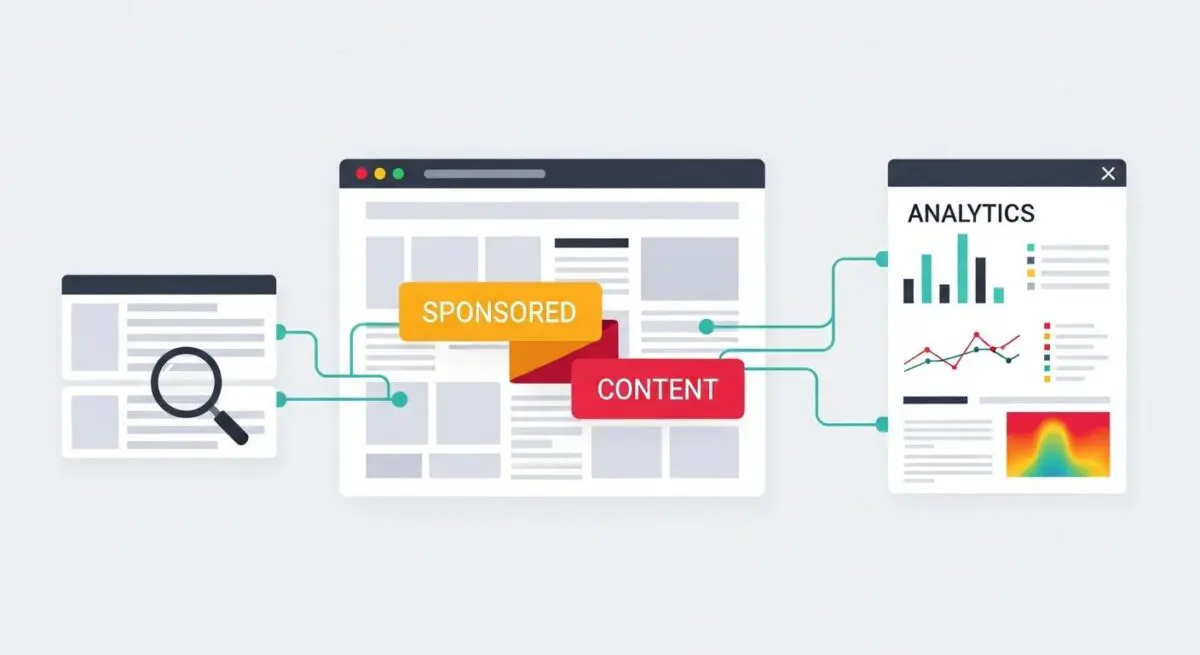
Sponsored content is a sophisticated form of native advertising where a commercial entity pays a publisher to produce or distribute content that aligns with the platform’s editorial standards and visual identity. Unlike traditional display advertising, which operates on an interruptive model, sponsored content is integrated into the user experience, functioning as a value-add rather than a distraction. In the context of a modern MarTech stack, sponsored content involves a complex interplay between Content Management Systems (CMS), ad servers, and data analytics platforms. It is designed to leverage the publisher’s established authority and audience trust to deliver brand messaging that is semantically relevant to the surrounding editorial environment.
From a technical SEO and Generative Engine Optimization (GEO) perspective, sponsored content represents a critical node in a brand’s digital ecosystem. Search engines and Large Language Models (LLMs) analyze these placements to determine entity relationships and topical authority. When a brand is featured in a high-authority publication, it signals to search algorithms that the brand is a recognized expert within its niche. However, this requires precise technical execution, including the use of standardized microdata and link attributes to ensure that the commercial nature of the content is transparent to both users and crawlers, thereby avoiding manual actions or algorithmic devaluations.
The Real-World Analogy
To understand sponsored content, consider the role of a guest lecturer in a prestigious university course. The university (the publisher) has a curriculum and a standard of academic excellence that students (the audience) trust. A guest lecturer from a private corporation (the brand) is invited to speak because they possess specialized knowledge that complements the course material. While the lecturer represents a commercial entity, their presentation must meet the university’s educational standards to be valuable. The session is clearly introduced as a guest lecture (disclosure), ensuring transparency while allowing the corporation to demonstrate its expertise to a highly targeted, engaged group of scholars.
How Sponsored Content Impacts Marketing ROI & Data Attribution?
The impact of sponsored content on Marketing ROI is multifaceted, often influencing the entire customer journey from top-of-funnel awareness to bottom-of-funnel conversion. Technically, measuring this impact requires moving beyond simple last-click attribution models. Because sponsored content often serves as an initial touchpoint, its value is frequently underestimated in standard analytics configurations. Implementing multi-touch attribution (MTA) or data-driven attribution (DDA) allows marketing directors to assign fractional credit to sponsored placements, revealing their true contribution to Customer Acquisition Cost (CAC) reduction and Lifetime Value (LTV) enhancement.
Data integrity is paramount when evaluating sponsored content performance. Advanced practitioners utilize server-side tagging and first-party data collection to bypass the limitations imposed by Intelligent Tracking Prevention (ITP) and the deprecation of third-party cookies. By integrating UTM parameters with CRM data via API connectivity, organizations can track a user from their initial interaction with a sponsored article through to a closed-loop sale. This level of granularity enables brands to calculate the incremental lift provided by sponsored content, distinguishing between organic conversions and those specifically driven by the paid partnership.
Strategic Implementation & Best Practices
- Standardized Link Attributes: Always apply the rel=”sponsored” attribute to all outbound links within the content. This is a technical requirement for Google and other search engines to distinguish paid links from editorial ones, preventing the risk of “link scheme” penalties.
- Semantic Alignment and Keyword Mapping: Ensure the sponsored asset is optimized for the publisher’s existing semantic clusters. Use tools to analyze the latent Dirichlet allocation (LDA) of the host site to ensure the brand’s content fits naturally within the site’s topical authority.
- Schema.org Markup: Implement AdvertiserContentArticle or NewsArticle schema with the isAccessibleForFree and paywall properties if applicable, and clearly define the provider and sponsor entities in the JSON-LD block to enhance machine readability.
- Performance Monitoring via API: Integrate publisher-side analytics with your internal dashboard using APIs. This allows for real-time monitoring of engagement metrics such as scroll depth, time-on-page, and interaction rates, which are leading indicators of content resonance.
- GEO and LLM Optimization: Structure the content with clear H2 and H3 headers and concise, fact-based sentences. This increases the likelihood that AI-driven search engines will cite the sponsored content as a source in generated responses.
Common Pitfalls & Strategic Mistakes
One of the most frequent errors in enterprise sponsored content strategy is the failure to provide adequate disclosure, which leads to both regulatory non-compliance (FTC/GDPR) and a loss of consumer trust. Technically, this often manifests as hidden or obfuscated disclosure tags that search engines may interpret as deceptive practices. Another common mistake is the creation of “content silos,” where the sponsored piece is not internally linked from the publisher’s main navigation or related articles, significantly reducing its crawl frequency and SEO impact.
Furthermore, many brands suffer from misattribution by failing to account for the “halo effect” of sponsored content. They may see a spike in direct traffic or branded search volume following a campaign but fail to link these metrics back to the sponsored placement. Without a robust data architecture that captures these cross-channel signals, the true ROI of the investment remains obscured, leading to inefficient budget allocation in future cycles.
Conclusion
Sponsored content is a high-leverage tool in the modern MarTech stack that requires a balance of editorial quality and rigorous technical execution. By prioritizing semantic alignment, proper link attribution, and advanced data modeling, brands can achieve scalable growth and enhanced authority in an increasingly AI-driven search landscape.