Executive Summary
- CodeWP utilizes domain-specific Large Language Models (LLMs) fine-tuned specifically for the WordPress ecosystem, including Core, WooCommerce, and ACF.
- The platform enhances development efficiency by generating syntactically correct PHP, JavaScript, and SQL tailored to WordPress Coding Standards (WPCS).
- Integration of AI-generated code facilitates the reduction of plugin bloat by allowing developers to implement lightweight, bespoke functional snippets.
What is CodeWP?
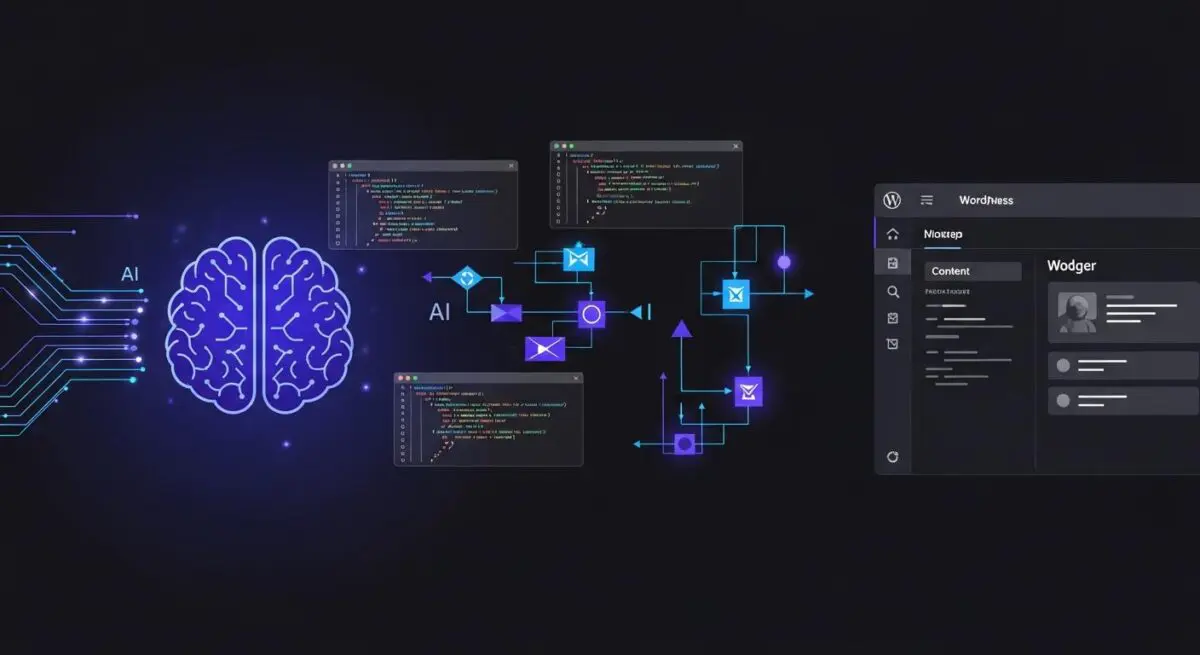
CodeWP is a specialized generative artificial intelligence platform engineered specifically for the WordPress ecosystem. Unlike general-purpose Large Language Models (LLMs), CodeWP is fine-tuned on a massive corpus of WordPress-specific data, including the WordPress Core codebase, plugin repositories, and official documentation. This domain-specific training allows the system to understand the nuances of the WordPress hook system (actions and filters), the WP_Query class, and the REST API, producing code that adheres to WordPress Coding Standards (WPCS).
At its architectural core, CodeWP functions as a productivity accelerator for developers and agencies. It provides specialized modes for popular frameworks such as WooCommerce, Advanced Custom Fields (ACF), and Elementor. By leveraging high-density vector embeddings of WordPress-specific logic, it minimizes the hallucinations common in generic AI models, ensuring that generated snippets are not only syntactically correct but also contextually relevant to the WordPress environment.
The Real-World Analogy
Imagine hiring a master carpenter who has spent thirty years working exclusively on Victorian-era homes in a specific historic district. While a general contractor might understand how to build a wall, the specialist knows exactly where the hidden load-bearing beams are, which specific nails are required by local preservation laws, and how the plumbing was originally routed. CodeWP is that specialist for WordPress; it does not just write code; it writes code that respects the specific building codes and structural idiosyncrasies of the WordPress CMS.
How CodeWP Impacts Server Performance & Speed Engineering?
CodeWP significantly impacts server-side optimization by facilitating the creation of lightweight, bespoke functional snippets that replace heavy, multi-purpose plugins. In a traditional WordPress environment, site owners often install “kitchen-sink” plugins to achieve minor features, which introduces significant overhead in the form of unnecessary PHP execution, excessive database queries, and redundant CSS/JS assets. By generating precise code for specific tasks, CodeWP helps maintain a minimal footprint, reducing the Time to First Byte (TTFB) and improving overall server response times.
Furthermore, CodeWP can be utilized to optimize database interactions. It can generate efficient SQL queries or WP_Query arguments that avoid expensive operations like ‘meta_query’ on large datasets without proper indexing. By producing code that utilizes WordPress’s built-in caching mechanisms, such as the Transients API or Object Cache, CodeWP ensures that the generated logic is scalable and does not degrade performance under high-traffic conditions.
Best Practices & Implementation
- Strict Code Review: Always subject AI-generated snippets to manual peer review to ensure logic alignment with the specific project requirements and security protocols.
- Utilize Specialized Modes: Use the platform’s specific modes (e.g., WooCommerce or ACF) to ensure the AI utilizes the most efficient API functions available for those extensions.
- Implement in Child Themes or Functionality Plugins: Never add generated code directly to a parent theme; instead, use a child theme’s functions.php or a dedicated site-specific plugin to ensure update persistence.
- Sanitization and Validation: Verify that all generated code includes proper WordPress security functions such as sanitize_text_field() and wp_verify_nonce() before deployment.
Common Mistakes to Avoid
One frequent error is the “copy-paste” fallacy, where developers implement generated code without verifying its impact on the existing codebase, potentially leading to hook conflicts. Another mistake is neglecting to test the code in a staging environment; even domain-specific AI can produce logic that conflicts with specific server configurations or PHP versions. Finally, over-reliance on AI can lead to a lack of understanding of the underlying architecture, making it difficult to debug complex issues when they arise.
Conclusion
CodeWP represents a paradigm shift in WordPress development, offering a sophisticated toolset for generating high-performance, standards-compliant code. When integrated into a professional workflow with proper oversight, it significantly enhances development velocity and site efficiency.