Executive Summary
- Automated website orchestration utilizing machine learning for layout reconstruction and structural migration.
- Integration with Google Cloud Platform (GCP) for containerized, high-availability managed WordPress hosting.
- Algorithmic optimization of Core Web Vitals through automated server-side and front-end performance tuning.
What is 10Web AI?
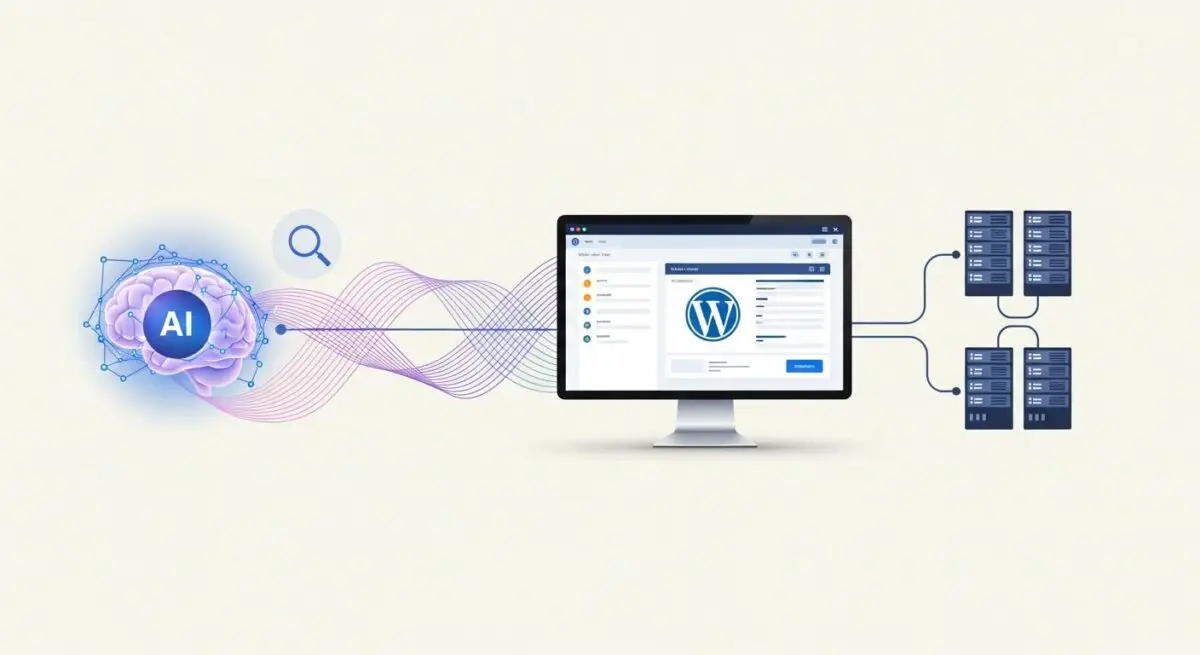
10Web AI is an integrated platform that combines artificial intelligence with managed WordPress hosting to automate the lifecycle of website creation, management, and optimization. At its core, the system utilizes machine learning algorithms to analyze existing web pages or user-provided parameters, subsequently reconstructing them within the WordPress ecosystem using standardized block-based or Elementor-driven architectures. This process involves the automated generation of layouts, content, and media assets, significantly reducing the manual overhead associated with traditional theme development.
Beyond site generation, 10Web AI functions as a comprehensive hosting orchestrator. It leverages a specialized software stack designed for high-concurrency environments, ensuring that the AI-generated sites adhere to strict performance standards. By integrating AI directly into the hosting control panel, the platform automates complex tasks such as image optimization, CSS minification, and database maintenance, which are typically handled by disparate plugins in a standard WordPress installation.
The Real-World Analogy
Imagine a master architect who possesses a sophisticated 3D scanner and an automated construction crew. Instead of manually drawing blueprints and hiring individual contractors to lay every brick, the architect scans an existing building and instantly instructs the crew to replicate it on a superior, earthquake-proof foundation using more efficient materials. 10Web AI acts as this architect, scanning design patterns and structural elements to rebuild them on a high-performance cloud infrastructure, ensuring the new version is faster and more stable than the original.
How 10Web AI Impacts Server Performance & Speed Engineering?
10Web AI impacts server performance by deploying sites on a containerized infrastructure powered by Google Cloud Platform (GCP). This architecture utilizes LXD containers, which provide isolated environments for each WordPress instance, ensuring that resource allocation is consistent and not affected by neighboring tenants. The platform integrates a proprietary PageSpeed Booster that operates at the server level to optimize the delivery of assets. This includes the generation of critical CSS to eliminate render-blocking resources and the implementation of advanced caching mechanisms like FastCGI and Nginx-level object caching.
From a speed engineering perspective, the AI-driven optimization engine automatically converts images to next-generation formats like WebP and implements lazy loading without requiring manual configuration. By offloading these processes to the server-side infrastructure, the platform reduces the execution time of the PHP engine and minimizes the payload delivered to the client’s browser. This results in significant improvements to Largest Contentful Paint (LCP) and First Contentful Paint (FCP), which are critical metrics for search engine optimization and user experience.
Best Practices & Implementation
- Structural Auditing: Always review the DOM depth of AI-generated layouts to ensure that the reconstruction process has not introduced excessive div nesting, which can impact browser rendering speed.
- Cache Policy Configuration: Leverage the platform’s built-in caching layers rather than installing third-party optimization plugins to avoid software conflicts and redundant processing.
- Staging Environment Utilization: Use the automated staging feature to test AI-generated content updates or plugin additions before deploying to the production environment to maintain site stability.
- Edge Delivery Optimization: Ensure that the integrated Cloudflare Enterprise CDN is active to distribute static assets across edge nodes, further reducing latency for global traffic.
Common Mistakes to Avoid
A frequent error is the over-reliance on automated content generation without performing a manual SEO and technical audit, which can lead to repetitive metadata or non-optimized header hierarchies. Another common mistake is failing to verify the mobile responsiveness of reconstructed layouts; while the AI attempts to maintain fluid design, complex elements may require manual CSS adjustments to pass Cumulative Layout Shift (CLS) requirements on specific mobile viewports.
Conclusion
10Web AI represents a sophisticated convergence of machine learning and managed hosting, designed to streamline WordPress deployment through automated orchestration and server-side optimization. Its impact on performance is driven by a containerized cloud architecture that prioritizes Core Web Vitals and efficient resource management.