



Key Points
- Transition from keyword density to Cite-ability to secure Attribution Share in AI Overviews and RAG pipelines.
- Deploy Entity-Attribute-Value (EAV) mapping via advanced JSON-LD to anchor brand facts within LLM knowledge graphs.
- Optimize Information Gain Scores by structuring unique, non-derivative data into semantic chunks for vector database ingestion.
The AI Search Context: Entering the Zero-Search Era
By the end of 2026, 80% of all consumer search journeys are projected to begin and end within a generative AI interface, bypassing traditional search engine results pages entirely (Gartner). This paradigm shift marks the end of the traditional search engine optimization era. Generative Engine Optimization represents the definitive evolution of digital visibility designed for a post-keyword landscape. Large Language Models and Retrieval-Augmented Generation systems now synthesize information rather than merely listing blue links.
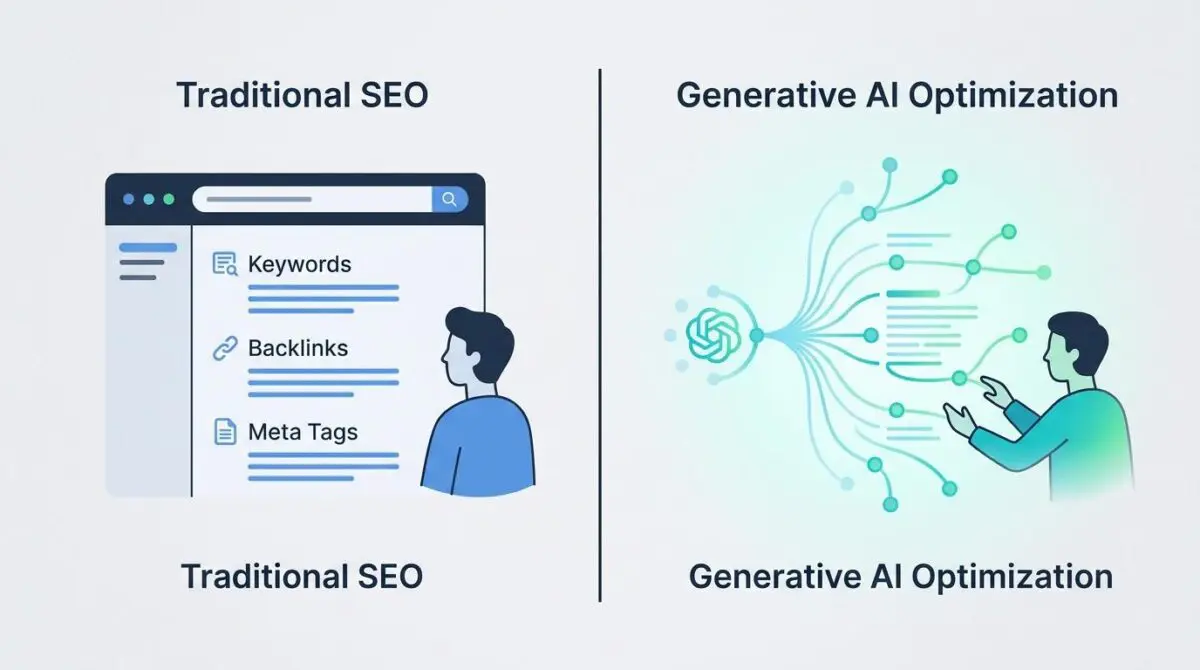
Traditional SEO focuses on domain authority and keyword density. GEO prioritizes the cite-ability of content and its semantic alignment with the latent space of models like GPT-5, Gemini 2.0, and Claude 4. The zero-click phenomenon has been superseded by zero-search experiences. AI Overviews satisfy user intent directly within the chat interface. Traditional traffic metrics are rapidly being replaced by Attribution Share. Organizations failing to transition to a GEO-first framework risk becoming invisible to automated agents.
Core Architecture and Pillars of GEO
To dominate the generative search landscape, architects must understand the underlying mechanics of LLM retrieval. Generative engines rely on complex vector mathematics to determine which sources to cite.
Core Architecture & Pillars
Authoritative Citation Engineering
LLMs use probabilistic weights to determine which sources to cite in a RAG pipeline. GEO focuses on increasing the ‘Source Salience’ by aligning content with the specific token sequences that models recognize as high-confidence factual anchors. This involves using ‘N-shot’ style structuring within the HTML to make facts easily extractable by LLM scrapers.
Semantic Vector Alignment
Search has moved from lexical matching to vector-space proximity. GEO involves optimizing content so its embedding (created via models like text-embedding-3-small) sits closer to the centroid of relevant user clusters. This is achieved by using ‘Concept Clustering’ rather than keyword repetition.
Entity-Attribute-Value (EAV) Mapping
Generative engines rely on structured knowledge graphs to verify facts. GEO focuses on defining entities (Brands, People, Products) and their relationships (Attributes) using standardized vocabularies. This reduces the ‘hallucination’ risk for the AI, making it safer for the model to recommend the brand.
Information Gain Score Optimization
AI models are increasingly trained to ignore redundant data. GEO prioritizes ‘Information Gain’—the inclusion of unique, non-derivative data points that do not exist in the model’s baseline training set. If content is a rewrite of existing web data, it has a low retrieval priority.
Authoritative Citation Engineering
LLMs utilize probabilistic weights to select sources within a RAG pipeline. Increasing source salience requires aligning content with token sequences that models recognize as high-confidence factual anchors. A 2025 study from the Stanford AI Lab revealed that content utilizing ‘Structured Citation Formatting’ is 4.5x more likely to be selected as a primary source by RAG-based search engines compared to standard long-form prose (Stanford AI Research). This data underscores the necessity of fact-dense modules in modern CMS architectures.
Semantic Vector Alignment
Search algorithms no longer rely on lexical matching but instead evaluate vector-space proximity. Structuring content to map closely to the centroid of relevant user clusters requires advanced concept clustering. You can explore the foundational Generative Engine Optimization research to understand how embeddings dictate retrieval priority. Content must be modeled to reflect deep semantic relevance across related entities.
Entity-Attribute-Value (EAV) Mapping
Generative engines depend on structured knowledge graphs to verify claims and mitigate hallucination risks. Defining entities and their relationships using standardized vocabularies provides safe recommendation pathways for the AI. This explicit definition anchors your brand within the global knowledge graph.
Information Gain Score Optimization
AI models are trained to penalize redundant data. Prioritizing unique, non-derivative data points ensures your content exceeds the baseline training set. Google has heavily documented the Information Gain score as a critical metric for evaluating content originality. Derivative content simply will not survive in a RAG-first ecosystem.
The Execution Roadmap for Semantic Content
Transitioning to a GEO framework requires a systemic overhaul of how content is authored, structured, and delivered. The following roadmap outlines the precise technical steps required.
Implementation Roadmap
Transition to Semantic Content Architecture
Restructure all top-tier pages using the ‘Claim-Evidence-Source’ framework. Ensure every primary heading (H2) corresponds to a high-intent semantic query found in LLM latent space tools.
Deploy Multi-Layered Schema Markup
Inject advanced JSON-LD specifically using ‘Speakable’, ‘FactCheck’, and ‘Dataset’ schemas. Ensure all data points are mapped to Wikidata or DBpedia URIs to provide the AI with external validation anchors.
Optimize for RAG Chunking
Format content into 300-500 word ‘Semantic Chunks’ separated by clear, descriptive headers. This matches the standard chunk size used in vector database ingestion, ensuring the AI doesn’t truncate vital information.
Enable Real-Time Indexing Hooks
Configure the WordPress Index Now API and Google Indexing API to trigger immediately upon content updates. This ensures that the ‘Freshness’ component of the GEO algorithm prioritizes your content over stale training data.
Restructuring Content Architecture
Every top-tier page must adopt the Claim-Evidence-Source framework. Primary headings must correspond to high-intent semantic queries identified in LLM latent space tools. This ensures that web crawlers can easily extract definitive answers. Advanced JSON-LD deployment using Speakable and FactCheck schemas provides external validation anchors.
Real-Time Indexing and RAG Chunking
Content must be formatted into precise semantic chunks. This matches the standard ingestion sizes used when generating semantic vector embeddings for vector databases. Configuring real-time indexing hooks guarantees that the freshness component of the GEO algorithm favors your updates over stale training data.
Technical Implementation
Executing Entity-Attribute-Value mapping requires precise schema configuration. Deploying advanced JSON-LD connects the Organization schema to specific niche properties. This explicitly defines the brand’s position within the AI’s knowledge graph.
{ "@context": "https://schema.org", "@type": "WebPage", "mainEntity": { "@type": "Article", "about": "Generative Engine Optimization", "mentions": [ { "@type": "Thing", "name": "Retrieval-Augmented Generation", "sameAs": "https://en.wikipedia.org/wiki/Retrieval-augmented_generation" }, { "@type": "Thing", "name": "Large Language Model", "sameAs": "https://en.wikipedia.org/wiki/Large_language_model" } ], "educationalLevel": "Advanced", "assesses": "GEO Strategy" } }Validation & Future-Proofing
Maintaining dominance in a generative ecosystem requires continuous monitoring of attribution metrics. Standard rank tracking is obsolete in the zero-search era.
Validation & Monitoring
- Verify GEO performance using ‘Attribution Audit’ tools like Perplexity’s ‘Pages’ or proprietary LLM rank trackers.
- Monitor the ‘Citation Rate’ in Google Search Console’s AI Overview reports to measure brand visibility in generative summaries.
- Use Python scripts to query GPT-4o APIs periodically to check if your brand remains the top-cited source for specific industry prompts.
- Conduct regular competitive gap analysis to maintain a high Information Gain Score relative to baseline LLM training data.
Architects must verify GEO performance using attribution audit tools and monitor citation rates directly within AI Overview reports. Querying APIs periodically allows teams to confirm that the brand remains the top-cited source for target prompts. Conducting regular competitive gap analysis ensures a high Information Gain Score relative to baseline LLM training data. As models evolve, continuous adaptation of your semantic chunking strategy will be necessary.
Navigating the intersection of traditional SEO and Generative Engine Optimization (GEO) requires a precise architecture. To future-proof your enterprise stack for AI Overviews and LLM discovery, connect with Andres at Andres SEO Expert.