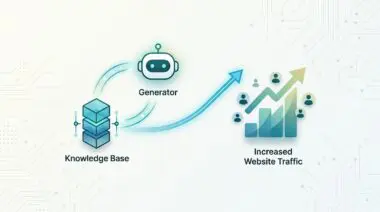
Key Points
- Transition from traditional keyword indexing to multidimensional intent fulfillment utilizing a Multimodal Optimization Framework.
- Implement Direct Answer Architecture via JSON-LD microdata to capture voice and conversational agent queries (AEO).
- Optimize for Citation Probability to ensure your content is synthesized and cited by LLMs in RAG-based summaries (GEO).
The AI Search Context
By mid-2026, 72% of B2B purchase journeys begin with an AI-mediated query rather than a traditional search engine results page (Source: Gartner AI Search Trends 2026). This staggering metric underscores a permanent paradigm shift in digital discovery. The search landscape has evolved from a linear keyword-matching system into a complex ecosystem of multidimensional intent fulfillment. Organizations must now architect their digital presence to satisfy distinct algorithmic layers simultaneously.
Traditional search engines historically relied on inverted indices to match user queries with document text. Today, the underlying architecture has shifted toward vector databases and approximate nearest neighbor algorithms. At the foundation, traditional SEO ensures technical crawlability and indexation across legacy search engine results pages. Answer Engine Optimization acts as the immediate resolution layer, engineered specifically for voice assistants and zero-click conversational interfaces.
Generative Engine Optimization represents the most advanced frontier, where content is explicitly structured for synthesis by Large Language Models. This convergence mandates a transition from merely ranking for clicks to optimizing for citation probability. A Multimodal Optimization Framework is no longer optional for enterprise visibility. It is the definitive blueprint for ensuring your proprietary data is retrieved, synthesized, and prominently cited across the entire spectrum of modern AI search engines.
Core Architecture & Pillars
Core Architecture & Pillars
Semantic Vector Alignment (GEO)
LLMs process content as high-dimensional vector embeddings. To rank in AI summaries, content must exhibit high cosine similarity to the query’s vector space, moving beyond keyword density to semantic relevance.
Direct Answer Architecture (AEO)
Answer engines prioritize ‘concise clarity’ and data-rich snippets. Technical implementation involves the use of Microdata and JSON-LD to define entities, relationships, and direct answers to common ‘What, Why, How’ queries.
Citation Probability Optimization (CPO)
GEO introduces the concept of being the ‘Authoritative Source’ for a specific fact. This requires content to include unique, verifiable data or proprietary research that triggers the LLM’s citation logic during the synthesis phase.
Traditional Authority Signaling (SEO)
Core SEO metrics like E-E-A-T (Experience, Expertise, Authoritativeness, Trustworthiness) and backlink profiles serve as the quality filter before content is ever considered for generative synthesis or RAG inclusion.
Understanding the distinction between these pillars is critical for deploying a successful Multimodal Optimization Framework. Each pillar addresses a specific algorithmic mechanism within the broader search ecosystem. Failing to optimize for one can bottleneck your visibility across the others.
Semantic Vector Alignment
Modern language models process content as high-dimensional vector embeddings rather than isolated text strings. This fundamental shift requires content to exhibit high cosine similarity to the query’s mathematical vector space. Optimization moves entirely beyond keyword density and into the realm of deep semantic relevance.
Within enterprise content management systems, this is implemented by utilizing semantic-heavy architectures that support advanced structured data. Ensuring your post’s vector representation aligns with the latent intent of the user query is paramount. The system must map topical relationships comprehensively to capture the full semantic cluster.
Advanced embedding models analyze the contextual relationship between words, sentences, and entire documents. To achieve optimal semantic vector alignment, content creators must utilize a highly descriptive and context-rich vocabulary. This approach ensures the resulting vector coordinates sit closely to the user’s multi-layered query intent.
Direct Answer Architecture
Answer engines operate on the principle of concise clarity and immediate data retrieval. They prioritize data-rich snippets that can be instantly served to users without requiring a subsequent click. Technical implementation relies heavily on Microdata and JSON-LD to define entities and their relationships.
Sites must utilize custom schema templates to present data in a highly structured format. This allows AI scrapers and voice-activated agents to instantly parse direct answers to common interrogative queries. The architecture must eliminate ambiguity, providing a singular, definitive response to targeted questions.
Natural language processing algorithms deployed by answer engines look for distinct subject-predicate-object structures. By engineering your content to deliver these semantic triples cleanly, you drastically reduce the computational overhead required for parsing. This efficiency directly correlates with higher inclusion rates in voice search and zero-click interfaces.
Citation Probability Optimization
The core objective of Generative Engine Optimization (GEO) is establishing your domain as the authoritative source for a specific fact. This requires content to include unique, verifiable data or proprietary research. Such data triggers the LLM’s internal citation logic during the synthesis phase.
A 2026 MIT Media Lab study found that ‘Citation Saturation’—the number of distinct high-authority sources corroborating a fact—is the #1 ranking factor for SearchGPT’s citation engine (Source: MIT Media Lab 2026). Consequently, your content must be engineered to be referenced in RAG-based (Retrieval-Augmented Generation) summaries like Google AI Overviews.
To support this, infrastructure must leverage persistent object caching and lightning-fast server response times. LLM crawlers must perceive the site as a reliable, high-performance node within the global knowledge graph. Latency during the crawl phase can severely degrade your citation probability by limiting the data available during real-time synthesis.
Traditional Authority Signaling
Core SEO metrics remain the foundational quality filter before content is ever considered for generative synthesis. Experience, Expertise, Authoritativeness, and Trustworthiness evaluate the baseline credibility of a domain. Robust backlink profiles continue to serve as a primary indicator of external consensus.
Technical SEO factors such as site speed, HTTPS, and mobile responsiveness act as the technical gatekeeper for AI search engines. They determine if a page is healthy enough to be processed and indexed by LLMs. Without this foundation, advanced generative optimization efforts will fail to yield results.
Generative engines rely on traditional search indices to populate their retrieval databases. If a page fails to meet the baseline quality thresholds of traditional search algorithms, it will never enter the RAG pipeline. Therefore, legacy SEO practices remain a non-negotiable prerequisite for AI visibility.
The Execution Roadmap
Implementation Roadmap
Entity-Based Schema Implementation
Inject comprehensive JSON-LD schema for ‘Organization’, ‘Person’, and ‘FAQ’ into the WordPress header. Explicitly define ‘sameAs’ links to authoritative social profiles and wikidata entries to solidify entity identity.
Prompt-Optimized Content Structuring
Reorganize content using H2 and H3 tags as ‘prompts’ followed by a 40-60 word ‘answer’ paragraph. This structure mimics the input/output pattern that LLMs utilize during retrieval-augmented generation.
API-First Indexing & Connectivity
Utilize the IndexNow API and Google’s Indexing API to ensure that new ‘GEO-optimized’ content is crawled within seconds, allowing real-time AI engines like SearchGPT to access the data before it is stale.
Citation Velocity Monitoring
Track brand mentions and citation counts using AI-specific analytics tools. Analyze search console ‘impressions’ in AI Overviews vs. traditional organic results to adjust semantic density.
Deploying a Multimodal Optimization Framework requires a precise, sequential execution roadmap. Each step builds upon the previous, creating a comprehensive digital architecture optimized for algorithmic synthesis. The focus must remain on structured data, content formatting, and rapid indexation.
Entity-Based Schema Implementation
The first phase involves injecting comprehensive JSON-LD schema directly into the document header. This must include explicit definitions for Organization, Person, and FAQ entities. By establishing clear entity boundaries, you reduce the computational load required for an LLM to understand your content.
Furthermore, explicitly defining sameAs links to authoritative social profiles and Wikidata entries solidifies your entity identity. This interconnected web of verified profiles acts as a cryptographic signature for your brand. It ensures that generative engines attribute data to your specific organizational entity without hallucination.
Proper entity resolution allows AI systems to disambiguate your brand from similarly named entities. When an LLM can confidently map a piece of data to your verified knowledge graph node, citation probability increases exponentially. This is the bedrock of establishing digital authority in a generative landscape.
Prompt-Optimized Content Structuring
Content must be reorganized to mirror the input and output patterns that LLMs utilize during retrieval-augmented generation. This involves utilizing H2 and H3 tags as simulated prompts. Following these headings, you must provide a highly concentrated 40-60 word answer paragraph.
This specific structure drastically improves the extraction efficiency for AI crawlers. By feeding the engine exactly what it expects in a format it natively understands, you increase the likelihood of inclusion in generative summaries. The surrounding content can then expand on the topic for human readers.
Vector databases process information in discrete chunks rather than monolithic documents. The 40-60 word constraint perfectly aligns with the optimal token limits for RAG context windows. Structuring your content in these highly dense, semantic blocks ensures maximum information retention during the retrieval phase.
API-First Indexing & Connectivity
In the era of real-time AI search, waiting for passive crawling is an obsolete strategy. Organizations must utilize the IndexNow API and specialized indexing endpoints to push content directly to search engines. This ensures that newly optimized content is crawled and processed within seconds of publication.
Allowing real-time AI engines to access fresh data before it becomes stale is a critical competitive advantage. API-first indexing guarantees that your proprietary research is available for synthesis during breaking industry events. It minimizes the latency between content creation and LLM citation.
Furthermore, proactive indexing optimizes your overall crawl budget. By directly notifying engines of specific URL changes, you prevent AI bots like GPTBot and ClaudeBot from wasting resources on unmodified pages. This highly efficient data pipeline is essential for large-scale enterprise deployments.
Technical Implementation
Executing the Direct Answer Architecture requires precise deployment of structured data. The following JSON-LD configuration demonstrates how to properly format an FAQ block for optimal LLM extraction. This code must be injected into the head of your document or rendered dynamically via your CMS.
{
  "@context": "https://schema.org",
  "@type": "FAQPage",
  "mainEntity": [
    {
      "@type": "Question",
      "name": "What is GEO vs SEO?",
      "acceptedAnswer": {
        "@type": "Answer",
        "text": "SEO focuses on ranking in traditional search results via keywords and links, while GEO (Generative Engine Optimization) focuses on being cited in AI-generated summaries by optimizing for LLM retrieval patterns and semantic relevance."
      }
    }
  ]
}
This specific schema structure explicitly defines the question and the accepted answer. It removes all ambiguity, allowing an answer engine to confidently extract the text string for a voice response or featured snippet. Ensure that the text within the schema exactly matches the visible text on the page to maintain trust signals.
Validation & Future-Proofing
Validation & Monitoring
- Execute specific brand queries in SearchGPT and Perplexity to verify real-time retrieval performance.
- Confirm response attribution by verifying if the generative engine cites your primary URL as a factual source.
- Activate the Google Search Console ‘AI Overview’ filter to isolate generative impression metrics from standard organic traffic.
- Monitor long-term ‘Citing Source’ visibility percentage to measure the authority of proprietary research data.
Implementing the framework is only the first half of the equation. Continuous validation is required to ensure your architecture remains aligned with rapidly evolving LLM algorithms. This involves executing specific brand and informational queries across platforms like SearchGPT and Perplexity.
You must rigorously verify real-time retrieval performance and confirm accurate response attribution. If a generative engine utilizes your data but fails to cite your primary URL, your citation probability optimization requires adjustment. Tracking brand mentions and citation counts using AI-specific analytics tools is now a mandatory operational procedure.
Furthermore, activating specialized search console filters allows you to isolate generative impression metrics from standard organic traffic. Monitoring your long-term Citing Source visibility percentage provides a clear metric for the authority of your proprietary research. This data dictates your ongoing semantic density adjustments and content strategy refinement.
Log file analysis must also be adapted to track the crawling behavior of AI-specific user agents like Google-Extended and GPTBot. By understanding which sections of your site these bots prioritize, you can further refine your internal linking and schema deployment. The future of search belongs to those who actively engineer their data for machine synthesis.
Navigating the intersection of traditional SEO and Generative Engine Optimization requires a precise architecture. To future-proof your enterprise stack for AI Overviews and LLM discovery, connect with Andres at Andres SEO Expert.