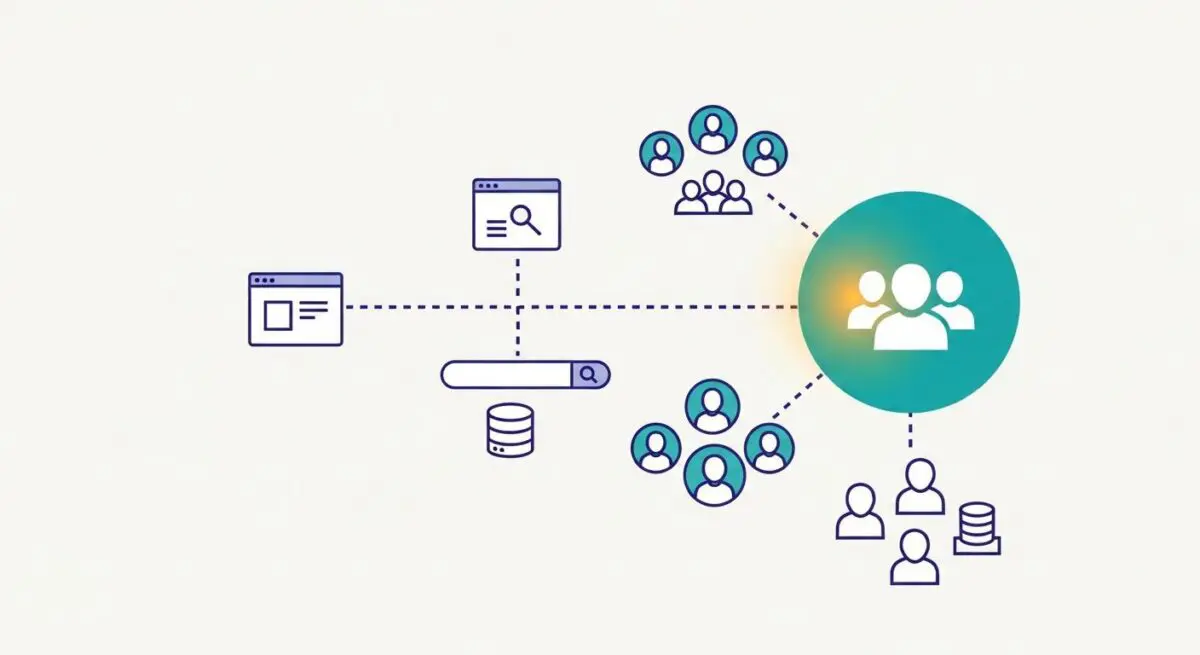
Executive Summary
- Unified Data Ingestion: Aggregating first-party data from disparate silos into a single, persistent, and normalized schema.
- Real-time Identity Resolution: The process of stitching anonymous and known identifiers into a 360-degree “Golden Record” for each user.
- Downstream Orchestration: Serving as the authoritative stateful layer for stateless AI agents and programmatic SEO workflows.
What is Customer Data Platform?
A Customer Data Platform (CDP) is a specialized data architecture designed to ingest, normalize, and persist first-party customer data from fragmented sources into a unified, persistent profile. Unlike traditional Customer Relationship Management (CRM) systems, which are often limited to manual entries and sales pipeline tracking, a CDP operates at the API level. It processes high-velocity behavioral signals, transactional records, and demographic attributes in real-time to create a single source of truth accessible to other systems.
Technically, a CDP functions as an operational layer between data collection points (SDKs, webhooks, and server-side trackers) and activation platforms. It performs identity resolution, which is the algorithmic matching of disparate data points—such as hashed email addresses, device IDs, and browser cookies—to a specific individual. This ensures that data remains consistent across the entire marketing and automation stack, providing a reliable foundation for advanced data modeling and AI-driven decision-making.
The Real-World Analogy
Imagine a high-end hotel concierge who maintains a live-updating ledger of every interaction you have ever had with the brand, regardless of the location. Instead of the concierge having to call the restaurant, the spa, and the housekeeping department separately to understand your preferences, the ledger is always open and accurate. If you mentioned a peanut allergy in London, the hotel’s automated kitchen in Tokyo already has that information before you arrive. The CDP is that master ledger, ensuring every “department” (or automation tool) has the exact same context at the exact same time.
Why is Customer Data Platform Critical for Autonomous Workflows and AI Content Ops?
In the era of AI Content Ops, a CDP serves as the essential “context window” for autonomous agents. Most automation workflows are stateless, meaning they do not inherently remember previous interactions. By piping CDP data into these workflows via REST APIs or JSON payloads, engineers provide the stateful memory required for hyper-personalization. For example, an AI agent generating a dynamic landing page can query the CDP to determine a user’s previous purchase history and technical proficiency, adjusting the technical depth of the content in milliseconds.
Furthermore, CDPs are vital for programmatic SEO and GEO-targeting. By leveraging real-time location data and behavioral triggers stored within the CDP, brands can execute automated content updates that respond to shifting user intent. This reduces the reliance on static databases and allows for a more fluid, data-driven content lifecycle that scales without manual intervention.
Best Practices & Implementation
- Implement Strict Schema Validation: Ensure all data entering the CDP adheres to a predefined schema to prevent downstream automation failures caused by malformed JSON payloads.
- Prioritize Server-Side Tracking: Use server-to-server integrations (CAPI) to bypass client-side limitations such as ad-blockers and browser privacy restrictions, ensuring a more complete data set.
- Optimize for Low-Latency API Access: When selecting a CDP, prioritize providers that offer high-speed data egress to ensure that real-time personalization workflows are not bottlenecked by API response times.
- Leverage Deterministic Matching: For high-stakes automation triggers, rely on deterministic matching (exact identifiers) rather than probabilistic matching to maintain the highest level of data integrity.
Common Mistakes to Avoid
One frequent error is treating the CDP as a passive data lake or storage bucket rather than an active orchestration layer. Data that is not activated through webhooks or API calls provides no value to autonomous workflows. Another common mistake is neglecting data hygiene; if duplicate or corrupted profiles are allowed to persist, the AI agents relying on that data will produce inaccurate or irrelevant outputs, leading to a “garbage in, garbage out” scenario in the automation stack.
Conclusion
A Customer Data Platform is the foundational infrastructure for modern AI Automations, providing the unified, real-time context necessary for autonomous agents to execute personalized and efficient workflows at scale.