Executive Summary
- Centralizes disparate product data into a single source of truth for multi-channel distribution.
- Facilitates automated data enrichment and normalization for AI-driven content pipelines.
- Reduces latency in headless commerce architectures by providing structured, API-ready JSON payloads.
What is Product Information Management?
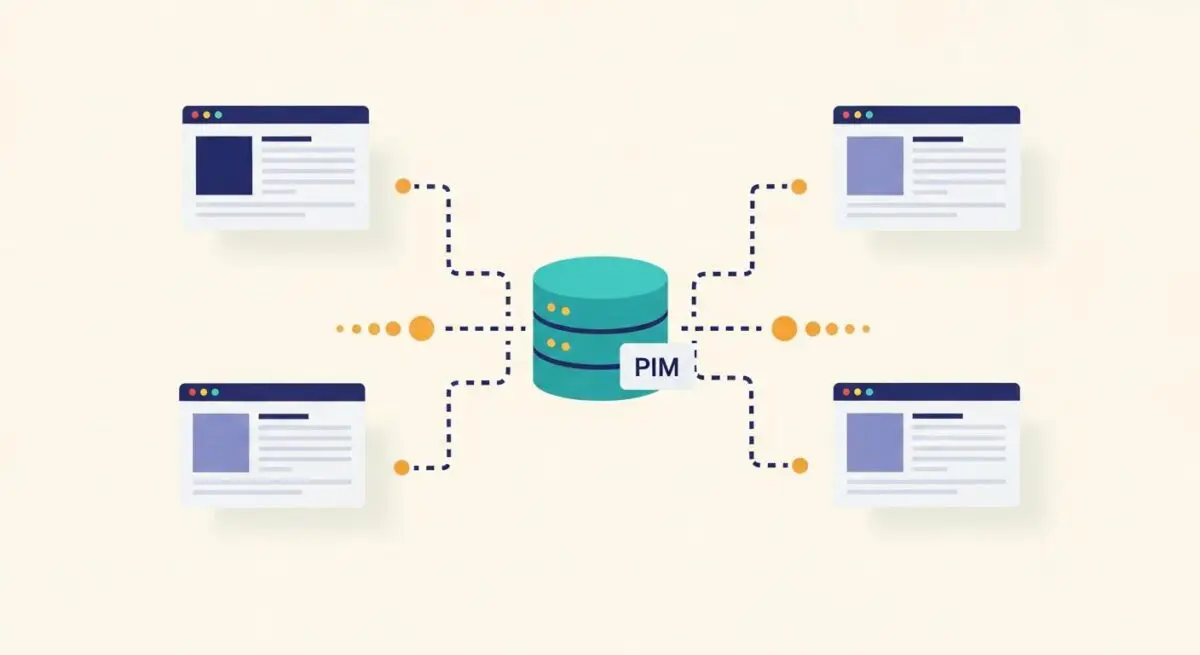
Product Information Management (PIM) is a specialized software framework designed to centralize, manage, and harmonize complex product data across an organization’s entire digital ecosystem. In the architecture of AI automations, a PIM serves as the authoritative repository for technical specifications, marketing descriptions, and localized media assets. It acts as a middleware layer that ingests raw data from Enterprise Resource Planning (ERP) systems and transforms it into structured, enriched formats suitable for multi-channel distribution.
By providing a unified interface for data governance, PIM systems eliminate data silos and ensure that every downstream application—from e-commerce storefronts to AI-driven search engines—consumes the same validated information. This structured approach is critical for maintaining data integrity in high-velocity programmatic environments where manual oversight is unfeasible and data consistency is paramount for brand authority.
The Real-World Analogy
Think of a PIM as the master conductor of a global orchestra. Without a conductor, every musician—representing different sales channels like Amazon, your website, or a mobile app—might play the same piece of music but at different tempos, volumes, or even in different keys. The PIM ensures that every instrument is reading from the exact same master score, updated in real-time, so the resulting performance is perfectly synchronized and professional across the entire concert hall, regardless of the listener’s location.
Why is Product Information Management Critical for Autonomous Workflows and AI Content Ops?
PIM is the foundational infrastructure for stateless automation and programmatic SEO. In AI content operations, Large Language Models (LLMs) require high-fidelity, structured data to generate accurate product copy without hallucinations. A PIM provides this via robust API endpoints, allowing AI agents to pull specific attributes—such as dimensions, materials, or compatibility—directly into content generation prompts with 100% accuracy.
Furthermore, PIM systems facilitate serverless architecture scaling by decoupling product data from the presentation layer. This allows for the rapid deployment of headless commerce solutions where product updates are pushed via webhooks to various front-ends simultaneously. For GEO (Generative Engine Optimization), a PIM ensures that the structured data (Schema.org) provided to search crawlers is consistent, increasing the probability of being cited as a primary source by AI search agents and improving visibility in LLM-driven discovery.
Best Practices & Implementation
- Implement Strict Schema Validation: Ensure all incoming data from suppliers or ERPs adheres to a predefined JSON schema to prevent downstream automation failures and maintain data purity.
- Leverage Webhook Triggers: Configure the PIM to emit events upon data updates, triggering automated cache purging, AI-driven content regeneration, or translation workflows in real-time.
- Standardize Taxonomy: Align product categories with global standards like GS1 or Google Product Taxonomy to optimize for AI-search discovery and cross-platform compatibility.
- Integrate Digital Asset Management (DAM): Link high-resolution assets directly to product SKUs within the PIM to automate image processing and CDN delivery for various device types and bandwidth constraints.
Common Mistakes to Avoid
A frequent error is treating a PIM as a simple spreadsheet or database; without proper workflow logic and attribute inheritance, it fails to provide the governance needed for automation. Another mistake is neglecting data normalization, which leads to inconsistent attributes that confuse AI models during content synthesis. Finally, many brands fail to decouple their PIM from their legacy CMS, creating technical debt and bottlenecks that prevent the agility required for modern, headless AI operations.
Conclusion
Product Information Management is the essential catalyst for scaling product-led growth through structured, API-first data ecosystems that empower AI-driven automation and global content distribution.