Key Points
- Elimination of Monolithic Bottlenecks: Decoupled architecture separates data storage from presentation, ending 18-month re-platforming cycles and enabling marketing teams to update UIs instantly without back-end engineering.
- Rise of Agentic Composable Architecture: Enterprises are leveraging Generative UI layers to assemble front-end components in real-time, delivering hyper-personalized experiences across AR/VR, mobile, and IoT via a single unified API.
- Capital Influx into API-First Models: Smart money is flowing into headless-native startups, securing 3.5x more Series B funding than traditional SaaS, as investors prioritize modularity, zero-maintenance UIs, and technical debt reduction.
Table of Contents
The Core Friction: Shattering the Monolithic Bottleneck
According to the 2026 Gartner Enterprise Architecture Report, 82% of Global 2000 companies have migrated at least 60% of their customer-facing applications to decoupled architectures to support AI-driven personalization and edge-side rendering.
This staggering statistic is not merely a reflection of a passing engineering trend. It represents a fundamental shift in how global enterprises are responding to market friction and evolving consumer demands.
For the better part of a decade, digital transformation initiatives have been severely crippled by the monolithic bottleneck. This architectural flaw creates a catastrophic delay where even a minor change to a website’s UI requires a full system rebuild and a risk-heavy deployment.
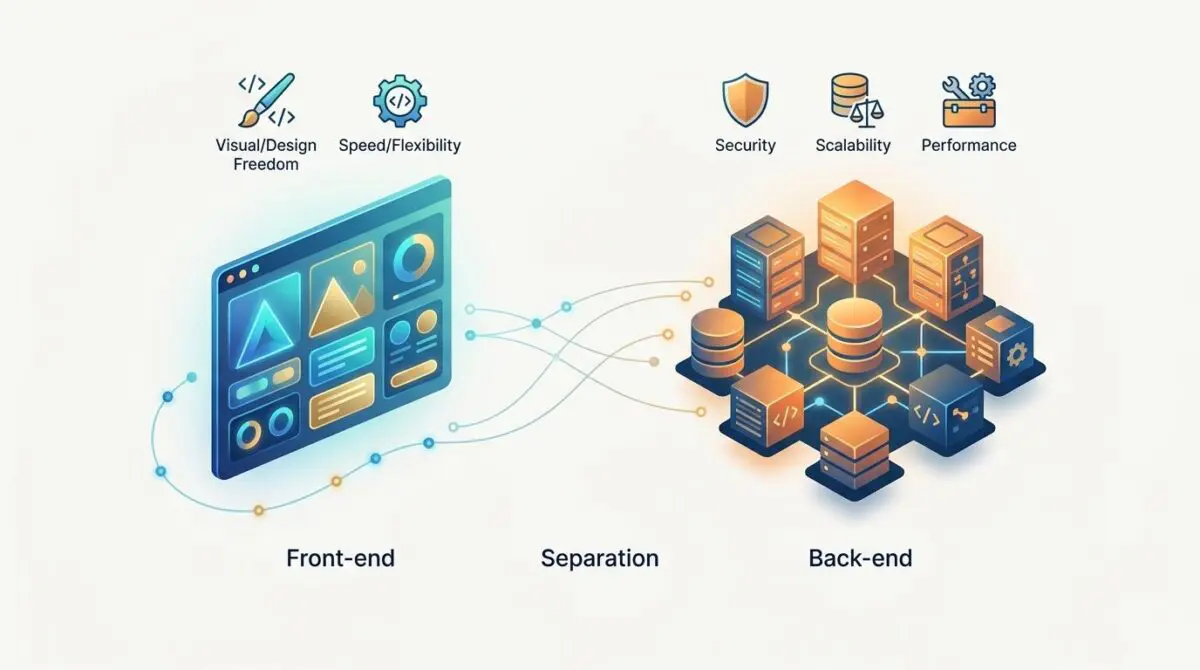
By separating the core concern of data storage from data presentation, Decoupled Architecture fundamentally solves this systemic paralysis. CEOs and technical founders are finally eliminating the agonizing 18-month re-platforming cycles that previously drained capital and killed market momentum.
Marketing and growth teams can now update front-end visuals instantaneously. They operate with complete autonomy, executing rapid A/B tests without ever involving back-end engineering or risking database stability.
Market Intelligence & Smart Capital Flow
Market Intelligence & Data
Omni-channel Efficiency
Forrester research from Q1 2026 reports that decoupled systems reduce the time-to-market for new digital channels by 92% compared to legacy monolithic suites.
Headless Market Valuation
IDC projects the specialized headless commerce and CMS market will reach a valuation of $18.4B by the end of 2026 as monolithic retail platforms are phased out.
Developer Retention Lift
A 2026 Stack Overflow Enterprise survey found that developers are 45% more likely to remain at firms utilizing modern decoupled stacks over legacy monolithic architectures.
Annual Debt Reduction
Analysis by Deloitte Digital shows large enterprises save an average of $1.2M annually in technical debt reduction costs after fully decoupling their core front-end.
The data presented above reveals a stark reality for legacy monolithic systems. Capital is rapidly abandoning closed ecosystems in favor of agile, API-first infrastructures.
Smart money recognizes that the future of enterprise software lies in seamless interoperability and unprecedented speed to market. Market dominance is currently being fiercely contested by AI-native delivery platforms like Vercel and Netlify.
These disruptors have successfully integrated LLM-orchestration directly into their edge networks, rendering traditional content delivery networks obsolete. Consequently, massive 2026 funding rounds led by Sequoia and SoftBank are flowing heavily into Data Mesh startups and API orchestration layers.
These emerging companies are automating the incredibly complex mapping between legacy back-ends and modern GraphQL-based front-ends. For a broader perspective on these macro-level technology movements, review Gartner’s Top Strategic Technology Trends for 2026.
The economic implications of this shift are profound. By reducing technical debt and accelerating deployment cycles, decoupled systems are directly impacting the bottom line and driving massive enterprise valuation increases.
The Strategic Deep Dive: Orchestrating the API-First Ecosystem
The transition to decoupled systems is fundamentally rewriting the underlying economics of software development. A 2026 analysis by Andreessen Horowitz reveals that ‘headless-native’ startups are currently securing 3.5x more Series B funding than traditional full-stack SaaS providers, as investors bet on the superior interoperability of API-first business models.
This massive capital influx underscores a deep psychological shift among tech founders and institutional investors alike. You can explore the broader implications of this structural pivot in this Andreessen Horowitz analysis on headless-native enterprise software.
Investors are simply no longer willing to fund platforms that lock valuable business data behind proprietary, inflexible presentation layers. Instead, they are backing infrastructure that treats the front-end as a lightweight, disposable, and highly adaptable asset.
This modular philosophy drastically reduces technical debt and dramatically increases developer retention. Engineers are free to use modern frameworks without being anchored to outdated legacy codebases.
The Rise of Agentic Composable Architecture
By 2026, the innovation landscape has shifted aggressively from simple headless setups to what industry insiders call Agentic Composable Architecture. Enterprises are now utilizing sophisticated Generative UI layers.
These advanced layers dynamically assemble front-end components in real-time, relying entirely on AI-predicted user intent. This strategy allows massive global brands to deploy hyper-personalized experiences across AR/VR, mobile, and IoT devices simultaneously.
Crucially, this multi-channel dominance is achieved using a single unified API back-end that remains completely untouched during front-end iterations. The operational leverage gained through this architecture is unprecedented in modern software history.
Product teams can now experiment with radically different user interfaces and conversion funnels without risking core database stability. To see exactly how this paradigm applies to modern retail environments, read Netguru’s research on modular and API-driven commerce adoption.
Overcoming Deployment Paralysis
Decoupling fundamentally changes the psychology of product deployment within large organizations. When the front-end is completely untethered from the back-end, the paralyzing fear of breaking mission-critical systems evaporates.
Engineering teams shift instantly from a defensive, maintenance-focused posture to an offensive, rapid-iteration mindset. This newfound agility translates directly to rapid market share acquisition.
Brands can launch highly targeted niche micro-sites, localized international campaigns, and experimental interfaces in a matter of days rather than quarters. The strict separation of presentation and logic serves as the ultimate catalyst for enterprise-wide digital innovation.
The Executive Action Plan: Future-Proofing the Stack
The next major evolution in this space is the imminent arrival of Autonomic Front-ends. Founders and C-level executives must actively prepare for a world where the front-end is no longer a set of static, hard-coded templates.
Instead, the enterprise interface will become a fluid, intelligent entity that autonomously discovers back-end API capabilities and configures itself on the fly.
Strategic Trajectory
- Pivot toward ‘Autonomic Front-ends’ to supersede traditional hard-coded template structures.
- Develop fluid interfaces capable of autonomous discovery and configuration of back-end API capabilities.
- Implement zero-maintenance UI architectures to eliminate manual front-end upkeep.
- Scale digital presence across thousands of micro-locales and niche devices with zero additional headcount.
- Future-proof the enterprise stack by migrating from static code to self-organizing interface systems.
Executing this ambitious trajectory requires a ruthless, top-down commitment to API-first design principles. Executives must mandate that all new digital initiatives strictly prioritize modularity and interoperability over monolithic convenience.
This aggressive move toward zero-maintenance UI architectures will allow enterprises to scale their digital presence seamlessly. Organizations will reach thousands of micro-locales and niche devices without ever needing to increase their core developer headcount.
Conclusion: The Autonomic Future
Decoupled Architecture has officially transcended its status as an experimental engineering philosophy. It is now the absolute baseline requirement for competing in a hyper-fast, AI-driven, multi-device ecosystem.
Companies that stubbornly cling to monolithic structures will find themselves rapidly outpaced by leaner, more adaptable, and heavily funded competitors. The separation of data and presentation is the master key to unlocking true operational agility.
It is time for leadership to dismantle the legacy bottleneck, embrace the composable future, and position their organizations for exponential scale.
Navigating the intersection of technology, capital, and market psychology requires a sharp strategy. To future-proof your business architecture and scale with precision, connect with Andres at Andres SEO Expert.