Executive Summary
- Agentic PLG (A-PLG) Transition: Market leadership has shifted from user-centric workflows to autonomous agent-centric models where AI agents act as the primary seat-holders.
- Efficiency-Adjusted Growth: The traditional Rule of 40 has been replaced by metrics that penalize high compute costs, favoring firms with Zero-Touch Expansion capabilities.
- Generative Engine Optimization (GEO): Modern SaaS infrastructure now prioritizes agent-readable manifests and structured API documentation over traditional SEO to capture autonomous procurement traffic.
The Paradigm Shift to Agentic Product-Led Growth
The fundamental architecture of software distribution is undergoing its most significant transformation since the transition from on-premise to cloud. In the current market landscape of 2026, the traditional Product-Led Growth (PLG) model—defined by human-centric friction reduction and self-serve onboarding—has evolved into Agentic Product-Led Growth (A-PLG). This shift represents a move away from designing for the human eye and toward designing for the autonomous agent. Category leaders like ServiceNow and HubSpot are no longer just optimizing for user clicks; they are architecting environments where AI agents perform the heavy lifting of administration, data entry, and cross-platform orchestration.
This evolution is driven by the realization that the primary bottleneck in SaaS scaling is no longer the cost of acquisition, but the cognitive load on the human user. As autonomous agents like Cognition’s Devin or Lattice’s automated management tiers take over the middle-management functions of software, the product itself must become a frictionless environment for these agents to operate. This has led to the rise of Horizontal PLG layers, where platforms act as operating systems for agents rather than just tools for employees.
Defining the Agentic PLG Framework
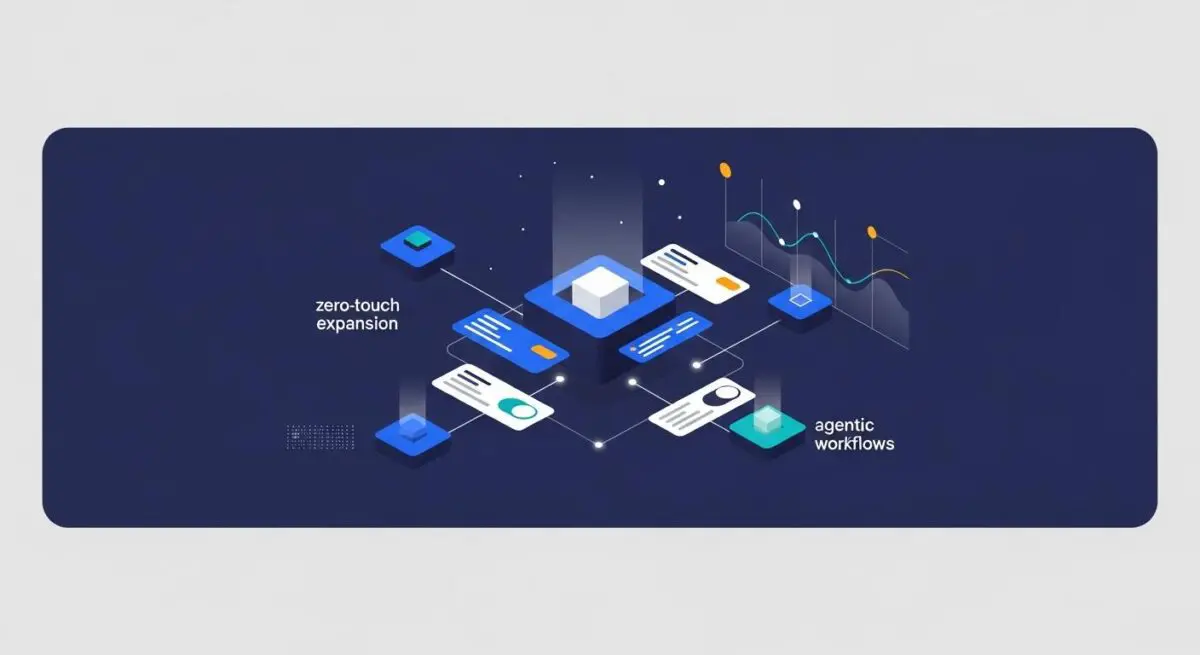
To understand the strategic implications, one must define Agentic Product-Led Growth as a strategy where the product’s value proposition, onboarding, and expansion loops are optimized for autonomous AI agents. Unlike traditional PLG, which relies on human behavioral psychology to drive conversion, A-PLG utilizes machine-to-machine efficiency. The product is no longer a static interface; it is a dynamic API-first ecosystem that allows agents to discover features, upgrade compute limits, and integrate with other tools without human intervention. This is the foundation of Zero-Touch Expansion, a revenue model where growth is triggered by the software’s own performance requirements rather than a procurement meeting.
Infrastructure and the Rise of Generative Engine Optimization
The technical stack supporting this new era has moved beyond centralized cloud environments to Distributed Edge Inference. This shift is critical for maintaining the low latency required for Real-Time Nudges—dynamic UI changes that occur as an agent or user interacts with the system. Furthermore, the discovery phase of the funnel has been completely rewired. Traditional SEO and SEM have been largely replaced by Generative Engine Optimization (GEO). SaaS firms are now building Agent-Readable manifests and structured API documentation designed specifically to be indexed by LLM-based search engines and autonomous procurement agents.
The Role of Shadow Proxies and Orchestration
Onboarding has also seen a radical overhaul. Instead of static video tutorials or tooltips, modern PLG stacks deploy Shadow Proxies. These are AI instances that work alongside the user in a sandboxed environment, performing tasks in real-time to demonstrate immediate value. This reduces the Time-to-Value (TTV) by allowing the user to see the finished product of an automated workflow before they even commit to a subscription. Orchestration layers like LangGraph are now standard components of the growth stack, managing the complex handoffs between human intent and agent execution.
The transition from traditional SaaS to Agentic PLG is much like the shift from a manual switchboard to a modern digital exchange. In the old model, every connection required a human operator to plug in a cord; in the new model, the system anticipates the connection, routes the traffic, and expands its own capacity based on the volume of data flowing through it, all while the human simply enjoys the clarity of the call.
The Economic Reality of Inference and Margins
While the potential for scale is unprecedented, the economics of A-PLG introduce new complexities. The industry has moved away from the Rule of 40 toward an Efficiency-Adjusted Growth Rate. This new benchmark accounts for the Inference Margin Squeeze—the rising cost-to-serve (CTS) associated with high GPU utilization. For many firms, the freemium model is no longer a viable entry point unless it is strictly token-gated. High-tier enterprises are increasingly favoring Proprietary Small Language Models (SLMs) trained on their own interaction data to maintain a competitive moat and control compute costs, leaving open-source models for non-critical support functions.
Regulatory Guardrails and Data Integrity
Strategic growth is now inextricably linked to compliance, particularly under the full implementation of the EU AI Act. SaaS providers must balance the desire for automated user profiling and predictive upselling with the requirement for Human-in-the-Loop (HITL) bypasses. This has forced a localization of data processing, where inference must happen within specific jurisdictions to satisfy data residency protocols. Companies that fail to provide algorithmic accountability risk significant fines, making data transparency a core feature of the product rather than a legal afterthought.
Andres’ Masterclass: The Big Picture
We are observing a fundamental decoupling of headcount from revenue. In the previous decade, a SaaS company’s growth was often mirrored by the growth of its sales and success teams. Today, the most elite firms are those that can achieve aggressive Net Revenue Retention (NRR) exceeding 130% with a fraction of the traditional staff. The competitive moat is no longer just the software’s features, but the proprietary data loops that train its internal agents. If your product does not become more intelligent with every agent interaction, you are building a commodity, not a platform.
I believe the real winners in this space will be those who master the transition from Product-Qualified Leads (PQLs) to Product-Qualified Accounts (PQAs) through total automation. By eliminating the manual outreach of the SDR/BDR layer and replacing it with autonomous value demonstrations, you aren’t just saving on payroll; you are increasing the velocity of your entire business. The goal is to build a system where the product sells itself not because it is cheap, but because it is an indispensable part of the customer’s own autonomous infrastructure.
Future-Proofing the Growth Engine
The path forward for SaaS founders requires a ruthless focus on infrastructure and agent-compatibility. As the shortage of specialized Growth Architects continues, the ability to design agentic workflows will become the primary differentiator between market leaders and legacy incumbents. The focus must remain on reducing the marginal cost of adding a new user while maximizing the efficiency of the compute power allocated to them.
Navigating the intersection of generative search and operational efficiency requires more than just tools—it requires a roadmap. If you’re ready to evolve your strategy through specialized SEO, GEO, Advanced Hosting Environments, or AI-driven automation, connect with Andres at Andres SEO Expert. Let’s build a future-proof foundation for your business together.