Executive Summary
- Edge-Agentic Architecture: The industry has transitioned from cloud-heavy processing to localized Neural Processing Units (NPUs) and Small Language Models (SLMs) to achieve sub-millisecond deterministic latency.
- Standardization via MCP: The Model Context Protocol (MCP) has become the universal standard for connecting autonomous agents to IoT data, effectively solving the legacy problem of semantic fragmentation.
- Economic ROI Benchmarks: AIoT implementation is delivering an 18.9% increase in equipment Customer Lifetime Value (LTV) and an 80% reduction in data backhaul costs through intelligent local filtering.
The Convergence of Connectivity and Cognition
In the current industrial landscape of 2026, the traditional Internet of Things (IoT) has undergone a fundamental metamorphosis. We have moved beyond the era of simple connectivity—where devices merely collected and transmitted data to a centralized cloud—into the era of the Artificial Intelligence of Things (AIoT). This paradigm shift represents the integration of decentralized edge intelligence with autonomous agentic orchestration. In simpler terms, AIoT is the transition from a system that records what is happening to a system that understands what is happening and acts upon it in real-time without human intervention.
The market valuation reflects this urgency, with the global AIoT sector reaching approximately $17.47 billion in 2026. Major infrastructure players like AWS and Microsoft are fueling this growth, with AWS alone guiding for $200 billion in capital expenditure this year to support the massive compute requirements of AI-driven IoT stacks. For the executive, AIoT is no longer a speculative technology; it is the primary driver of operational efficiency and a critical component of modern competitive moats.
Defining AIoT: The Nervous System Meets the Brain
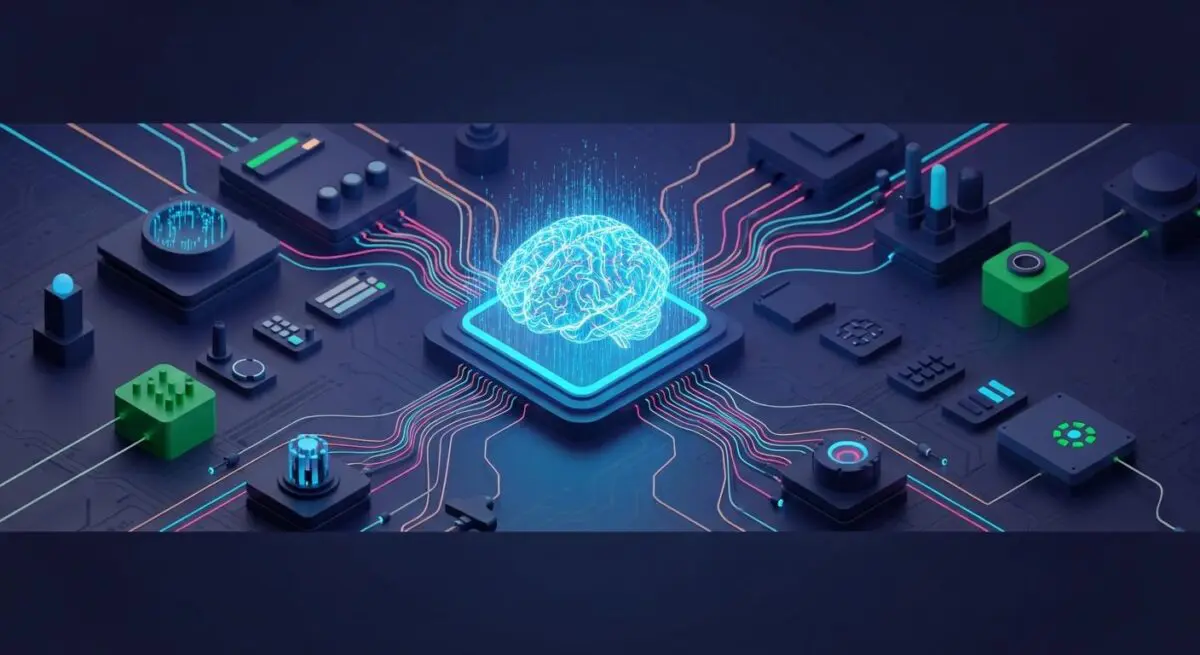
To understand AIoT strategically, one must view IoT as the nervous system of an organization and AI as the brain. In legacy systems, the nervous system sent signals to a distant brain (the cloud), resulting in latency and high bandwidth costs. AIoT embeds the brain directly into the nerve endings—the sensors and gateways at the edge of the network. This allows for localized decision-making through Neural Processing Units (NPUs) and Small Language Models (SLMs) that operate within the device itself.
This architectural shift is driven by the need for deterministic latency. In high-stakes environments like autonomous manufacturing or smart energy grids, a delay of even a few milliseconds can be catastrophic. By processing intelligence locally, AIoT systems ensure that critical actions are taken instantly, while only the most relevant, high-value data is sent back to the central repository for long-term analysis.
The Infrastructure of Autonomy: Protocols and Frameworks
The technical backbone of AIoT is defined by the rise of agentic orchestration. We are seeing the emergence of the Model Context Protocol (MCP), which has effectively become the USB-C for AI. With nearly 100 million monthly SDK downloads, MCP standardizes how autonomous agents connect to various data sources and tools, eliminating the silos that previously hindered large-scale IoT deployments. Furthermore, the Agent-to-Agent (A2A) protocol, now managed by the Linux Foundation, allows devices from different vendors to discover one another and delegate tasks autonomously.
Frameworks such as LangGraph for stateful workflows and CrewAI for role-based orchestration are now production standards. These tools allow developers to build complex, multi-agent systems where one agent might monitor sensor health while another optimizes energy consumption, all coordinated through a unified semantic layer. This level of sophistication is what enables the transition from simple automation to true machine autonomy.
Think of traditional IoT as a security camera that sends every minute of footage to a central office for a human to watch. AIoT is a security guard standing at the gate who only calls the office when an actual intruder is spotted, having already locked the doors and alerted local authorities themselves.
Market Dynamics and Strategic M&A
The consolidation of the AIoT market is accelerating as legacy tech giants race to own the full stack. Recent high-profile acquisitions, such as ServiceNow’s $7.75 billion purchase of Armis and IBM’s $11 billion acquisition of Confluent, signal a move toward integrated cyber-exposure management and real-time data streaming. These are not merely financial plays; they are strategic moves to enable autonomous agents to access and act upon live telemetry data across disparate enterprise systems.
SoftBank’s acquisition of Ampere Computing and ABB’s robotics division further illustrates the trend toward vertically integrated Physical AI stacks. By controlling both the silicon (NPUs) and the physical hardware (robotics), these companies are positioning themselves to dominate the industrial edge. For businesses, this means the choice of ecosystem is becoming as important as the choice of technology itself.
Economic Impact and Operational ROI
The financial justification for AIoT has shifted from vague efficiency gains to hard performance benchmarks. Organizations implementing AI-based lifecycle cost modeling have seen a 30% reduction in cost prediction errors. More importantly, the use of AIoT has led to an 18.9% increase in average equipment Customer Lifetime Value (LTV) by enabling predictive maintenance and personalized service tiers based on actual usage patterns.
From an operational standpoint, the reduction in data backhaul costs is perhaps the most immediate benefit. Industrial edge gateways are achieving an 80% reduction in bandwidth expenses by processing intelligence locally. This allows companies to scale their sensor networks without a linear increase in cloud storage and transmission costs, maintaining a healthy 5:1 LTV-to-CAC ratio in their service models.
Navigating Scalability Friction and Regulation
Despite the technological advances, significant friction points remain. Semantic fragmentation continues to plague data leaders, with many struggling to maintain consistent metrics across departments. This architectural entropy—the tendency to prioritize deployment speed over structural data standards—is the primary reason why over half of generative AIoT projects fail to scale beyond the proof-of-concept stage. Furthermore, the August 2, 2026, deadline for the EU AI Act has introduced mandatory accountability for high-risk AIoT systems in energy and healthcare, requiring rigorous data lineage and human-in-the-loop checkpoints.
Andres’ Masterclass: The Big Picture
In my analysis of the 2026 landscape, the real winners in the AIoT space are not those with the most sensors, but those with the most coherent data architecture. We are observing a massive divide between companies that treat AIoT as a series of isolated hardware upgrades and those that view it as a fundamental redesign of their operational workflow. The strategic moat of the future is built on the ability to orchestrate autonomous agents across a standardized semantic layer. If your data cannot be understood by an agent without human translation, your infrastructure is already obsolete.
We must also recognize that the shift to the edge is a capital allocation strategy as much as a technical one. By moving intelligence to the device, you are effectively federating your compute costs and reducing your reliance on centralized cloud providers. This decentralization provides not only a technical advantage in terms of latency but also a financial advantage in terms of long-term scalability and margin protection. The goal is to move from a reactive posture to a predictive, autonomous state where the system manages its own complexity.
Future-Proofing Your Autonomous Ecosystem
The transition to AIoT represents the most significant shift in industrial logic since the introduction of the internet itself. By merging the physical and digital worlds through autonomous agents and edge intelligence, businesses can unlock levels of efficiency and personalization that were previously impossible. However, success requires a disciplined approach to data standards and a clear understanding of the underlying infrastructure protocols.
Navigating the intersection of generative search and operational efficiency requires more than just tools—it requires a roadmap. If you’re ready to evolve your strategy through specialized SEO, GEO, Adavanced Hosting Environments, or AI-driven automation, connect with Andres at Andres SEO Expert. Let’s build a future-proof foundation for your business together.