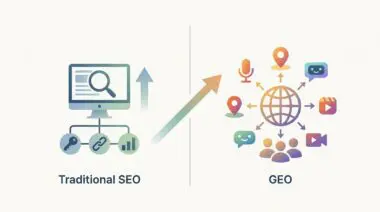
Key Points
- Semantic Structuring: Transition from long-form prose to modular, data-dense knowledge blocks optimized for RAG retrieval.
- Citation Density: Embed structured metadata and explicit source attribution to significantly increase LLM trust scores.
- Statistical Anchoring: Utilize verifiable quantitative facts to reduce hallucination risks and lower mathematical perplexity scores.
Table of Contents
The AI Search Context: A Paradigm Shift
Generative Engine Optimization (GEO) represents the most profound architectural shift in digital visibility since the inception of algorithmic crawling. By mid-2026, AI-driven search responses are projected to influence over $650 billion in e-commerce spend. This transition from traditional search engine results pages to synthesized, generative answers demands a fundamental restructuring of how data is formatted, stored, and delivered. Marketers and engineers can no longer rely on superficial keyword density or basic backlink profiles to secure organic real estate. The focus must pivot entirely toward optimizing for Retrieval-Augmented Generation (RAG) systems and the underlying mechanics of Large Language Models (LLMs).
Large Language Models operate on entirely different computational paradigms than legacy web crawlers. They prioritize semantic relevance, citation density, and the verifiable informativeness of isolated content chunks. To secure visibility in AI Overviews and modern discovery engines like Perplexity, enterprise architectures must adapt immediately. This means abandoning sprawling, unstructured prose in favor of modular, data-dense knowledge blocks. When an AI agent initiates a retrieval sequence, it calculates the cosine similarity between the user query and the vector embeddings of your content. If your text lacks structural clarity, it will be bypassed for highly structured, authoritative alternatives.
To fully grasp this evolution, one must understand the role of vector databases in modern search. Traditional engines rely on inverted indices, matching keywords to documents. Generative engines, however, convert your content into high-dimensional vector embeddings. These embeddings capture the deep semantic meaning of your text. If your content is poorly structured, its vector representation becomes noisy, making it nearly impossible for the retrieval algorithm to locate it during a user query. GEO is the practice of cleaning up that signal.
Core Architecture & Pillars
Core Architecture & Pillars
Citation Optimization & Attribution
Generative engines use weighted citation algorithms to verify the credibility of a claim. At the server level, this involves embedding structured metadata that links specific assertions to verifiable primary sources, allowing the LLM’s retriever to assign a higher ‘trust score’ during the ranking phase.
Statistical Anchoring
LLMs are prone to hallucination; therefore, they prioritize ‘hard data’ or quantitative facts during the RAG retrieval process. Content containing specific, up-to-date statistics provides a lower perplexity score for the model, making the information more ‘extractable’ for the final generative output.
Authoritative Tone & Fluency
The Princeton study found that ‘fluency’ and a ‘persuasive tone’ significantly impact the likelihood of being included in an AI summary. This involves optimizing the latent space representation of the text to align with the ‘Expert’ persona that models like GPT-4o or Claude 3.5 are trained to emulate.
Technical Terminology Integration
Using domain-specific jargon increases the ‘semantic density’ of the text. When an AI search engine processes a query, it looks for specific terminology that signals the content is a technical authority rather than a generalist overview.
The transition from ranking in static lists to being synthesized into a primary generative response requires mastering these core pillars. The first academic framework for optimizing content visibility within LLMs outlines these exact structural requirements. A core finding from the Princeton University study on GEO revealed that simply adding authoritative quotes to content improved its visibility in LLM responses by 41.5% compared to baseline SEO content. This staggering metric underscores the absolute necessity of transitioning to data-dense, modular blocks.
Generative engines utilize highly complex, weighted citation algorithms to verify the credibility of a claim during the inference phase. At the server level, this involves embedding structured metadata that links specific assertions to verifiable primary sources. This mechanism allows the retriever component of an LLM to assign a significantly higher trust score during the ranking phase. The economic impact of this shift is monumental, as reported by Gartner Research, highlighting why statistical anchoring is a non-negotiable element of modern architecture.
LLMs are inherently prone to hallucination, a vulnerability they mitigate by prioritizing hard data and quantitative facts during the RAG retrieval process. Content containing specific, up-to-date statistics provides a lower perplexity score for the model. This mathematical preference makes the information significantly more extractable for the final generative output. Fluency and an authoritative tone also govern the latent space representation of your text. Models like GPT-4o and Claude 3.5 are explicitly trained to emulate expert personas. Aligning your content with this persona increases the probability of inclusion in the final synthesis.
When discussing authoritative tone, it is vital to consider how transformer models tokenize text. Passive voice, filler words, and ambiguous phrasing create unnecessary tokens that dilute the core message. By enforcing a direct, declarative writing style, you optimize the token-to-information ratio. This efficiency is highly rewarded by AI search architectures, which are designed to synthesize maximum information with minimal computational overhead. Every sentence must serve as a standalone, verifiable fact.
Finally, integrating technical terminology increases the semantic density of your document. When an AI search engine processes a user query, it actively scans for domain-specific jargon. This terminology signals that the content is a definitive technical authority rather than a superficial overview. By elevating the semantic density of your content, you reduce the computational distance between the user query and your vector embeddings, ensuring faster and more accurate retrieval.
The Execution Roadmap
Implementation Roadmap
Implement Claim-Specific Schema
Update the site’s JSON-LD to include ‘ClaimReview’ or ‘Speakable’ schema. Specifically, use the ‘citation’ property within ‘Article’ or ‘WebPage’ schema to explicitly link your data points to academic or official government datasets.
Modularize Content for RAG
Refactor long-form blog posts into ‘Knowledge Blocks’ using H2 and H3 tags that contain a complete thought. Each block should follow the pattern: [Technical Claim] + [Supporting Statistic] + [Expert Quote]. This makes it easier for RAG systems to chunk your data.
Optimize for Semantic Distance
Ensure that your primary keywords and their semantic cousins (LSI) appear within the first 100 tokens of each section. This reduces the ‘computational cost’ for the AI to determine the relevance of your chunk during the initial retrieval phase.
Deploy Citation-Rich Fact Sheets
Create a dedicated ‘/fact-check/’ or ‘/data-points/’ directory. Use flat HTML tables instead of complex JavaScript-rendered charts to ensure that generative engine crawlers can read the raw data for inclusion in ‘Comparison’ type AI queries.
Implementing this theoretical framework requires a rigorous, technically sound execution roadmap. The first and most critical priority is to include ‘ClaimReview’ or ‘Speakable’ schema within your site’s JSON-LD architecture. This metadata explicitly links your proprietary data points to academic or official government datasets. It transforms your content from mere text into a verifiable, machine-readable knowledge graph entity. By providing explicit source attribution at the code level, you bypass the AI’s need to infer credibility, directly injecting your data into the highest tier of the retrieval hierarchy.
The next phase involves modularizing content specifically for RAG ingestion. Long-form prose is computationally expensive for LLMs to parse effectively and often leads to context degradation. Refactoring blog posts into isolated knowledge blocks using semantic heading tags accelerates the chunking process. Each block must contain a complete, verifiable thought. A standard, highly effective pattern involves pairing a technical claim with a supporting statistic and an expert quotation. This structural predictability drastically lowers the cognitive load on the AI retriever, ensuring your data remains intact during the synthesis phase.
The concept of modularizing content directly addresses the context window limitations of current LLMs. When a RAG system retrieves data, it does not ingest your entire webpage. It extracts specific chunks of text based on semantic similarity. If your chunks are too large, they exceed the context window and get truncated. If they are too small, they lack the necessary context for accurate synthesis. The structured formula represents the mathematically optimal chunk size for modern generative engines.
Optimizing for semantic distance is another critical technical requirement in the GEO roadmap. Primary keywords and their latent semantic counterparts must appear within the first 100 tokens of any given section. This proximity reduces the computational cost required for the AI to calculate the relevance of your chunk. It ensures your data passes the initial retrieval threshold before the synthesis phase begins. Failure to front-load semantic relevance often results in critical data being truncated or ignored entirely by the attention mechanisms of the transformer model.
Finally, deploying citation-rich fact sheets creates dedicated, high-density data repositories for generative crawlers. Utilizing flat HTML tables instead of complex JavaScript-rendered charts ensures raw data is immediately accessible to bots. Generative engines struggle with asynchronous rendering, making flat HTML the superior format for data ingestion. These tables become prime targets for inclusion in comparison-type AI queries, allowing your brand to dominate zero-click searches and AI Overviews.
Technical Implementation
Executing a Generative Engine Optimization strategy requires precise modifications to your server-side markup. The following JSON-LD configuration demonstrates how to properly structure a factual claim to maximize RAG retrieval. By utilizing the Article and Question schemas in tandem with explicit citation arrays, you provide generative engines with a perfectly formatted knowledge triple.
{ "@context": "https://schema.org", "@type": "Article", "headline": "GEO Strategy and LLM Retrieval", "citation": [ { "@type": "CreativeWork", "name": "GEO: Generative Engine Optimization", "url": "https://arxiv.org/abs/2311.09731" } ], "mainEntity": { "@type": "Question", "name": "How to optimize for AI search?", "acceptedAnswer": { "@type": "Answer", "text": "According to the Princeton study, adding citations and statistics can boost visibility by 30-40%." } } }This code snippet effectively maps your on-page assertions to external authorities. When an LLM crawls this page, the structured data acts as an anchor, validating the text against known entities in the model’s training data. This drastically reduces the perplexity of the information, flagging it as a high-confidence source suitable for generative synthesis.
Validation & Future-Proofing
Validation & Monitoring
- Verify implementation by querying the site’s key pages through the Perplexity API or SearchGPT Labs.
- Maintain a ‘Source Attribution’ log to audit if generative engines include the site in citation carousels.
- Monitor the ‘Search Appearance’ filter in Google Search Console to correlate traffic spikes with AI Overview impressions.
Verification and monitoring form the final, ongoing layer of a robust GEO strategy. Querying your key architectural pages through the Perplexity API or SearchGPT Labs provides immediate, empirical feedback on retrieval performance. Maintaining a strict source attribution log allows your engineering team to audit whether generative engines are successfully including your site in their citation carousels. This real-time telemetry is crucial for identifying indexing failures or semantic drift in your content blocks.
Monitoring the search appearance filter in Google Search Console is also essential for correlating traffic spikes with AI Overview impressions. As LLM architectures evolve and context windows expand, continuous testing of your knowledge blocks against new inference models will ensure sustained visibility. You must treat your content not as static pages, but as dynamic APIs that feed directly into the world’s most advanced neural networks.
Future-proofing your GEO architecture requires anticipating shifts in foundational models. As companies release updates like GPT-5 or Claude 4, the underlying embedding models will change. This means the semantic distance between your content and target queries may shift overnight. Establishing an automated testing pipeline that pings generative APIs with your target queries will alert you to these shifts. Proactive adaptation is the only way to maintain dominance in an ecosystem where the ranking algorithms are dynamic neural networks.
Navigating the intersection of traditional SEO and Generative Engine Optimization requires a precise architecture. To future-proof your enterprise stack for AI Overviews and LLM discovery, connect with Andres at Andres SEO Expert.