Executive Summary
- Leverages pixel-based tracking and server-side API integrations to re-identify and engage high-intent users across the programmatic ecosystem.
- Optimizes the Marketing Funnel by reducing Customer Acquisition Cost (CAC) through precise behavioral segmentation and dynamic creative optimization.
- Addresses the technical challenges of third-party cookie deprecation via first-party data strategies and Privacy Sandbox compliance.
What is Retargeting?
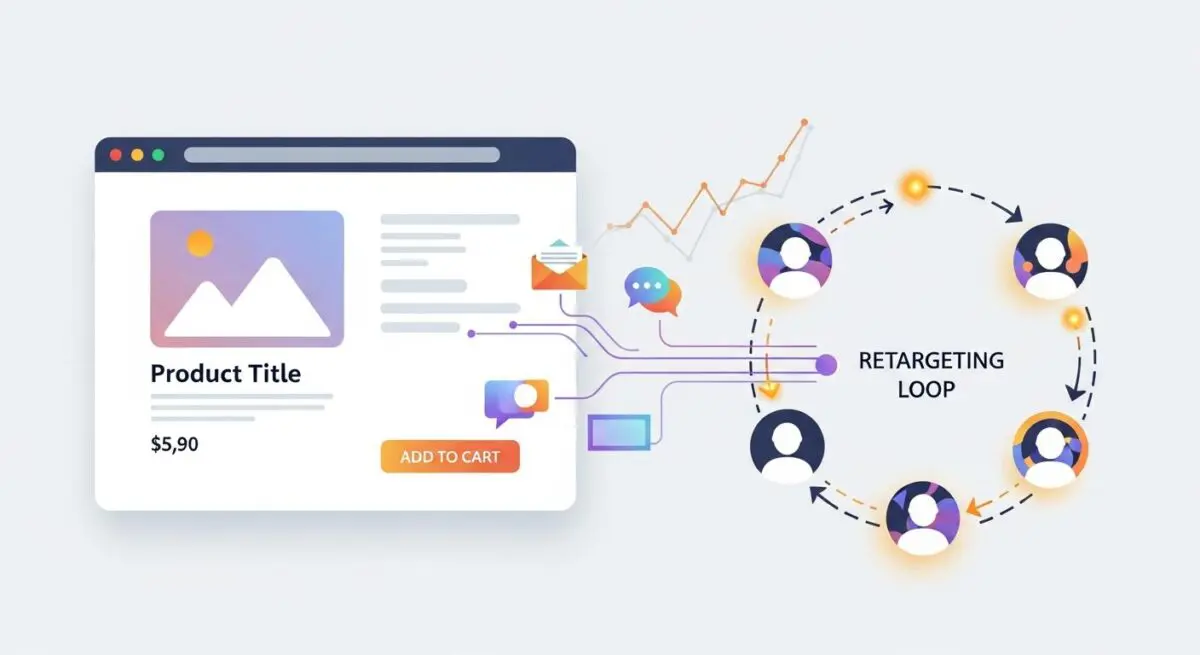
Retargeting, often referred to as remarketing in specific ecosystem contexts like Google Ads, is a sophisticated behavioral targeting methodology designed to re-engage users who have previously interacted with a digital property but did not complete a desired conversion action. Technically, it functions through the deployment of tracking scripts—commonly JavaScript snippets known as pixels—or through the integration of server-side APIs. When a user visits a website, the pixel fires, dropping a small data file (a cookie) in the user’s browser or capturing a unique device identifier. This identifier is then utilized by Demand-Side Platforms (DSPs) to recognize the user as they navigate other sites within an advertising network, allowing for the delivery of targeted ad impressions.
In the modern MarTech stack, retargeting has evolved from simple site-wide tracking to granular, event-based segmentation. This involves capturing specific telemetry such as SKU-level views, cart additions, or time-on-page metrics. These data points are processed within a Customer Data Platform (CDP) or a Data Management Platform (DMP) to create highly specific audience segments. As the industry shifts toward a privacy-first paradigm, retargeting increasingly relies on first-party data and hashed identifiers (such as SHA-256 hashed email addresses) to maintain cross-platform persistence without relying on third-party cookies. This technical infrastructure ensures that marketing efforts are directed toward users with a demonstrated affinity, thereby increasing the probability of conversion through repeated exposure.
The Real-World Analogy
To understand retargeting from a high-level business perspective, imagine a high-end boutique concierge. A customer enters the store, spends ten minutes examining a specific Italian leather briefcase, asks about the stitching, but ultimately leaves without making a purchase. In a traditional marketing model, that interaction ends there. However, in a retargeting model, the concierge discreetly notes the customer’s interest. Later that day, as the customer sits down at a nearby cafe, the concierge arrives and places a small brochure for that exact briefcase on their table. The next morning, a personalized invitation to a private viewing of the leather collection is delivered to their office. The concierge isn’t shouting at every passerby on the street; they are specifically following up with an individual who has already demonstrated a high level of intent, providing relevant reminders until the customer is ready to finalize the transaction.
How Retargeting Impacts Marketing ROI & Data Attribution?
Retargeting is a primary driver of Marketing ROI because it focuses resources on the segment of the audience most likely to convert: those who are already aware of the brand. By targeting this high-intent group, organizations can significantly lower their Customer Acquisition Cost (CAC). From a data attribution standpoint, retargeting complicates the traditional ‘Last-Click’ model. It necessitates the use of Multi-Touch Attribution (MTA) or Data-Driven Attribution (DDA) models to accurately value the role of middle-of-the-funnel (MOFU) and bottom-of-the-funnel (BOFU) touchpoints. Without retargeting data, a conversion might be incorrectly attributed solely to the final search query, ignoring the multiple retargeted impressions that nurtured the lead toward that final action.
Furthermore, retargeting enhances data integrity by providing insights into the ‘path to conversion.’ By analyzing the latency between the initial site visit and the final conversion after multiple retargeted exposures, data scientists can model the optimal frequency and recency for ad delivery. This prevents ‘ad fatigue’ and ensures that the budget is not wasted on over-saturating users who are unlikely to convert. In the context of Search Engine Optimization (SEO) and Generative Engine Optimization (GEO), retargeting serves as a critical ‘safety net.’ While SEO drives top-of-funnel organic traffic, retargeting ensures that the value of that traffic is captured and nurtured, even if the user does not convert during their initial organic session.
Strategic Implementation & Best Practices
- Implement Burn Pixels: To maintain efficiency and user experience, it is critical to deploy ‘burn pixels’ or exclusion lists. Once a user completes the target conversion (e.g., a purchase or lead form submission), they must be immediately removed from the retargeting pool to prevent redundant ad spend and brand friction.
- Dynamic Creative Optimization (DCO): Utilize DCO to serve ads that automatically populate with the specific products or services the user viewed. This requires a robust product feed integration between the website’s CMS and the advertising platform’s catalog manager.
- Frequency Capping and Recency Decay: Set strict frequency caps (e.g., no more than 3 impressions per 24 hours) and implement bid modifiers that decrease as the time since the last site visit increases. This ensures that the most aggressive bidding occurs when the user’s intent is freshest.
- Server-Side Tagging: Transition from client-side browser tracking to server-side tagging (e.g., via Google Tag Manager Server-Side). This improves site performance by reducing the JavaScript load on the browser and increases data accuracy by bypassing some browser-based tracking preventions.
Common Pitfalls & Strategic Mistakes
One of the most frequent errors in enterprise retargeting is the failure to segment audiences based on the depth of their engagement. Treating a user who bounced from the homepage the same as a user who abandoned a high-value shopping cart leads to inefficient bidding and poor ROI. Another significant mistake is ignoring privacy regulations such as GDPR and CCPA. Failing to implement a robust Consent Management Platform (CMP) that synchronizes with retargeting tags can lead to legal non-compliance and the loss of data processing rights. Finally, many brands suffer from ‘attribution blindness,’ where they over-invest in retargeting because it shows high ‘view-through’ conversion numbers, without conducting incrementality testing to determine if those users would have converted anyway without the additional ad exposure.
Conclusion
Retargeting remains a cornerstone of high-performance digital marketing architecture, bridging the gap between initial discovery and final conversion through data-driven persistence. When implemented with technical precision and privacy compliance, it transforms anonymous traffic into measurable revenue growth.