Key Points
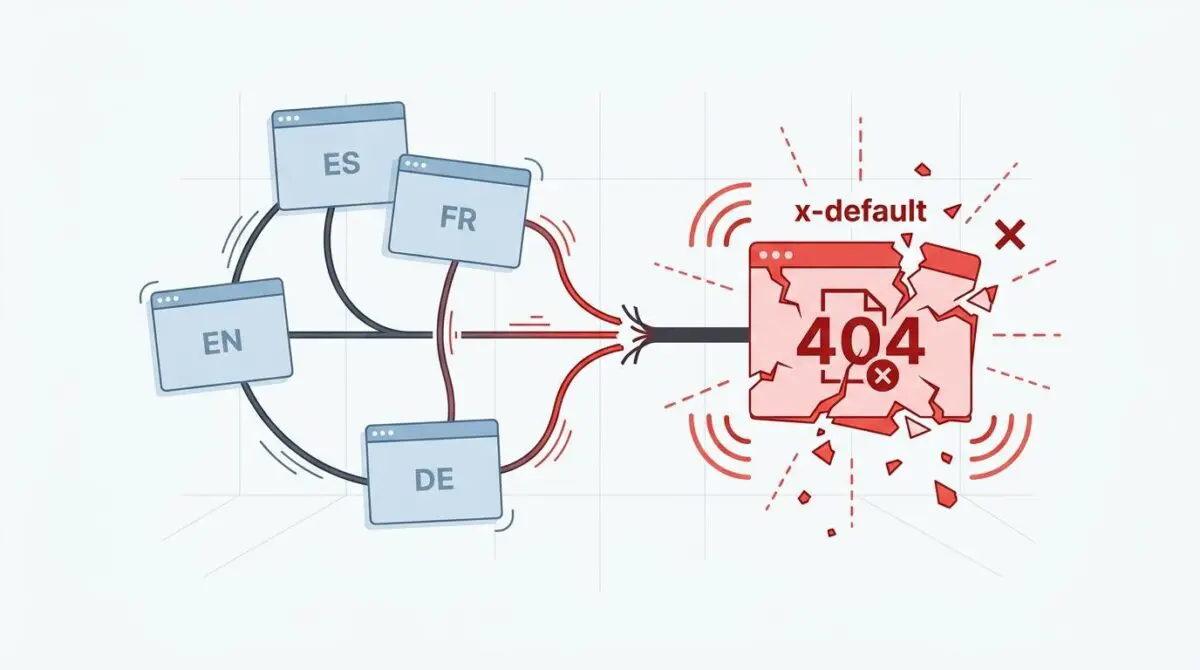
- A 404 status on an x-default hreflang tag breaks the bidirectional link requirement, causing search engines to invalidate the entire international cluster.
- Root causes typically involve permalink desynchronization, stale edge cache fragments, or relational mapping failures within multilingual plugins.
- Implementing dynamic fallback routing via application-level filters prevents cluster invalidation by intercepting dead URLs before they render in the DOM.
Table of Contents
The Core Conflict: Hreflang Cluster Invalidation
Industry data indicates that approximately 67% of international websites have at least one hreflang implementation error. Among these anomalies, broken return tags and 404 targets are the leading causes of complete cluster invalidation in Google’s index. When your architecture suffers from a Broken Hreflang x-default Fallback, the damage scales rapidly across your entire international footprint.
The x-default attribute is a critical technical signal designed to route users to a fallback page when no regional version matches their browser settings. If this specific tag points to a 404 status code, it creates a fatal logical break in your international mapping. Search engine crawlers like Googlebot immediately detect this missing node and invalidate the entire connected cluster.
Consequently, localized versions of your pages are treated as independent, orphaned URLs rather than a unified international set. This triggers massive duplicate content penalties and severely degrades your crawl budget. Server log analysis will frequently reveal Googlebot wasting resources hitting a non-existent URL originating from localized hreflang headers.
Without a valid x-default fallback, search engines cannot determine the default language state of the document. This forces the algorithm to guess the canonical version, often resulting in the wrong regional page ranking in global search engine results pages.
Root Cause Diagnostics
Identifying why an x-default tag is returning a 404 requires inspecting multiple layers of your server and application stack. A technical SEO study by Ahrefs highlights that these desynchronizations are a primary cause of global indexing failures. The failure is rarely a simple typo; it is usually a desynchronization between your database, caching layers, and SEO plugins.
Diagnostic Checkpoints
Permalink Slug Desynchronization
Database slug updates fail to trigger metadata cache refreshes.
Hardcoded Theme Templates
Static header strings become dead links during domain migration.
Multilingual Plugin Synchronization Failure
Relational mapping breaks when master pages change status.
Edge Cache and HTML Fragment Persistence
CDN nodes persist stale HTML head fragments after origin updates.
At the application layer, permalink desynchronization is incredibly common. When a page slug is updated directly in the database, the hreflang metadata stored in application-level object caches often fails to purge. This results in the injection of a defunct URL directly into the document head.
Similarly, multilingual plugins rely on complex relational tables to map translations to a master page. If this master page is moved to draft status or deleted, the relational bridge collapses. The plugin logic then blindly outputs the last known URL as the x-default fallback.
At the edge layer, aggressive caching rules in Varnish or Cloudflare Workers can trap stale HTML fragments. Even if the origin server outputs the correct x-default tag, the edge node continues serving the cached 404 target to search engine bots.
The Engineering Resolution
Fixing a broken x-default requires a systematic approach to clear dead links, reset plugin logic, and purge stale data across all nodes. Follow this roadmap to restore cluster integrity.
Engineering Resolution Roadmap
Identify and Redirect Dead URLs
Run a crawl using Screaming Frog filtered by ‘Hreflang’ tab to identify all 404 targets. Immediately implement a 301 redirect in the .htaccess or NGINX config from the broken x-default URL to the current live fallback page.
Correct Global SEO Plugin Settings
Navigate to your SEO plugin’s International/Hreflang settings (e.g., RankMath > General Settings > Others). Ensure the ‘Default’ page selected for the x-default attribute is live and published. Re-save settings to force a metadata refresh.
Audit XML Sitemap Logic
Inspect the XML sitemap. If hreflang is handled via sitemap, ensure the x-default entry matches the canonical URL of the fallback page. Exclude any 404 pages from the sitemap generation logic to prevent search engines from attempting to crawl the dead nodes.
Flush Global Caching Layers
Clear the WordPress Object Cache (via WP-CLI: wp cache flush), then perform a ‘Purge Everything’ on Cloudflare or your respective CDN to ensure the updated HTML head is propagated globally.
Executing these steps correctly ensures that both the application and edge layers are synchronized. The immediate 301 redirect is critical because it stops Googlebot from registering consecutive 404 errors while you fix the underlying application logic.
When auditing the XML sitemap, pay close attention to custom sitemap generators. If the sitemap relies on stale database transients, you must force a regeneration. Once the XML logic is secured, you must Clear the WordPress Object Cache using WP-CLI to drop any persistent Redis or Memcached strings.
Finally, purging the CDN ensures that no edge nodes are holding onto the broken HTML fragments. This guarantees that the next bot crawl receives the correct 200 OK status for your x-default target.
Resolution Execution: Dynamic Fallback Routing
To prevent hardcoded errors or plugin desynchronization from causing future 404s, you can implement a dynamic fallback at the application layer. This solution intercepts the x-default output and verifies its status before rendering it in the DOM.
The following PHP snippet utilizes WordPress core functions to perform a lightweight HEAD request on the defined x-default URL. If the URL returns anything other than a 200 OK status, it dynamically rewrites the fallback to the site’s homepage.
add_filter('wpseo_hreflang_xdefault', function($url) {
    $response = wp_remote_head($url);
    if (is_wp_error($response) || wp_remote_retrieve_response_code($response) !== 200) {
        return get_home_url(); // Dynamic fallback to homepage if defined x-default is broken
    }
    return $url;
}, 10, 1);
This automated failsafe ensures that your hreflang cluster never breaks due to a deleted page. By returning the home URL, the bidirectional link requirement of the hreflang protocol remains intact, preserving your international SEO architecture.
Implementing this code snippet within a custom functionality plugin or a child theme’s functions file isolates the logic from core updates. It acts as a permanent technical safeguard against human error during bulk content edits.
Validation Protocol & Edge Cases
After deploying the fixes and dynamic routing, rigorous validation is required. You must confirm that the new x-default tag resolves correctly from the perspective of external crawlers.
Validation Protocol
- Run curl -I on the x-default-URL to verify a 200 OK status code.
- Perform a Live Test in GSC URL Inspection to verify detected hreflang.
- Verify bidirectional cluster mapping using the Hreflang Checker extension.
- Monitor the Network Tab to ensure no 404s trigger from prefetch headers.
While standard WordPress environments respond predictably to these fixes, headless architectures introduce complex edge cases. In a decoupled setup using Next.js or Nuxt.js, the frontend relies on a distinct routing system separate from the backend API.
If the WordPress REST API outputs a relative path for the x-default page, the frontend might fail to construct the absolute URL correctly. This results in the hreflang tag resolving to a 404 on the frontend domain, even though the backend data appears flawless.
This silent failure can decimate an internationalization strategy without triggering backend alarms. Always validate the final rendered DOM on the production frontend domain, not just the API payload.
Autonomous Monitoring & Prevention
Manual validation is insufficient for enterprise environments. To future-proof your architecture, implement automated SEO monitoring scripts that perform daily HEAD requests on all URLs defined in your x-default attributes.
Integrating a CI/CD pipeline check that validates hreflang integrity before deploying theme or database changes is highly recommended. Furthermore, configuring server-side log alerts using the ELK Stack or Datadog allows you to flag internal link rot instantly.
By monitoring the referer headers in your server logs, you can detect when the site itself is generating 404 requests for x-default targets. This proactive observability prevents minor content updates from cascading into catastrophic cluster invalidations.
Advanced engineering teams can also leverage Make.com pipelines to parse XML sitemaps daily and trigger Slack alerts if an x-default node returns a non-200 status code. This ensures that technical SEO teams can patch the vulnerability before Googlebot crawls the broken cluster.
Conclusion
A Broken Hreflang x-default Fallback is a critical architectural failure that disrupts bidirectional indexing. By implementing dynamic routing failsafes, synchronizing your caching layers, and enforcing strict validation protocols, you can permanently secure your international clusters.
Navigating the intersection of technical SEO, server architecture, and generative search requires a precise roadmap. If you need to future-proof your enterprise stack, resolve deep-level crawl anomalies, or implement AI-driven SEO automation, connect with Andres at Andres SEO Expert.
Frequently Asked Questions
What happens if an x-default hreflang tag returns a 404 error?
When an x-default tag points to a 404 status code, it triggers a fatal logical break that invalidates the entire connected hreflang cluster. Search engines then treat localized pages as independent, orphaned URLs, leading to duplicate content penalties and significant crawl budget waste.
How does a broken x-default fallback impact international SEO rankings?
A broken fallback prevents search engines from identifying the default language state of a document. This forces the algorithm to guess the canonical version, which frequently results in the wrong regional page ranking in global search engine results pages (SERPs).
What are the primary causes of hreflang x-default desynchronization?
The primary causes include permalink slug updates that fail to trigger metadata cache refreshes, hardcoded links in theme templates during migrations, and aggressive edge caching (CDN) that persists stale HTML fragments after the origin server has been updated.
How can you resolve a broken hreflang cluster in WordPress?
Resolution involves a four-step roadmap: identifying and 301 redirecting dead URLs, re-saving SEO plugin settings to force a metadata refresh, auditing the XML sitemap logic to exclude 404 nodes, and flushing global caching layers including the WordPress Object Cache and CDN.
What is a dynamic fallback routing for hreflang?
Dynamic fallback routing is an engineering safeguard that uses a PHP filter to perform a lightweight HEAD request on the x-default URL before rendering. If the URL is broken, the logic automatically rewrites the fallback to the site’s homepage to preserve the bidirectional link requirement.
How should developers validate x-default hreflang integrity?
Validation requires running a curl -I command to verify a 200 OK status code, performing a Live Test in Google Search Console’s URL Inspection tool, and using browser extensions to verify bidirectional mapping across the entire international cluster.