Key Points
- Agentic Competitive Synthesis: Autonomous AI agents analyze real-time market signals and competitor behavior to enable sub-second price updates without human intervention.
- RAG-Enhanced Sentiment Elasticity: Large Language Models interpret unstructured customer reviews to adjust pricing based on real-time brand perception and consumer sentiment.
- Predictive Supply-Chain Integration: Advanced pricing models link directly to logistics algorithms, automatically adjusting prices based on forecasted restocking delays to preserve margins.
Table of Contents
The AI Landscape: Redefining Value in Real-Time
According to the 2026 Global Retail AI Index by McKinsey & Co, enterprises that successfully integrated agentic pricing models have reported an average 22% increase in gross margin compared to those relying on legacy ML systems. This staggering metric underscores a fundamental shift in how e-commerce operations scale today. We are no longer relying on simple regression models or static competitor matching algorithms.
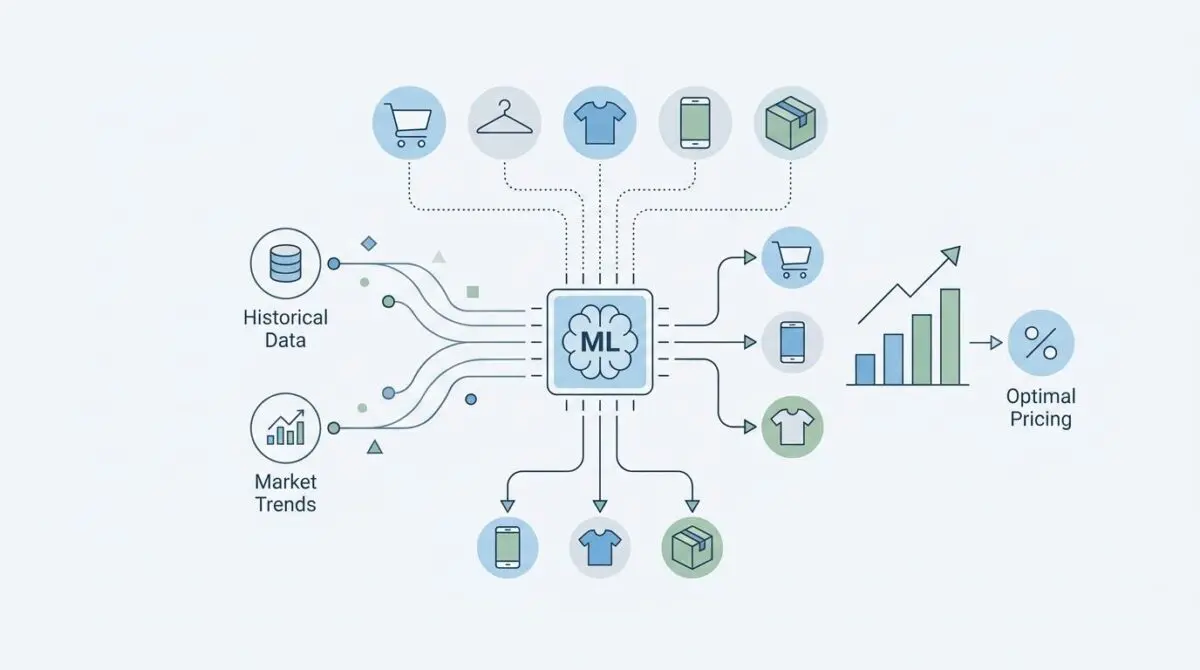
The modern digital storefront is now powered by Agentic Dynamic Pricing & Elasticity Intelligence. This sophisticated technology utilizes autonomous AI agents to analyze real-time market signals, inventory fluctuations, and competitor behavior. Large Language Models are actively deployed to interpret unstructured data, transforming qualitative signals into quantitative pricing adjustments.
For AI-driven search and RAG systems, this evolution means that search results are increasingly influenced by real-time value propositions rather than static index data. The digital marketplace has become remarkably fluid and hyper-responsive. Prices now reflect immediate supply-chain realities and highly specific consumer intent.
Retailers are consequently forced to move away from manual price setting toward automated, high-frequency intelligence layers. Legacy architectures simply cannot process the sheer volume of data required to remain competitive. Embracing agentic models is no longer an experimental luxury, but a baseline requirement for survival.
Core Concepts & Capabilities
Core Architecture & Pillars
Agentic Competitive Synthesis
This strategy involves deploying autonomous agents that use browser-based automation and API hooks to scrape competitor pricing, stock levels, and promotional cycles. These agents feed into a transformer model that calculates the ‘Market Competitive Index’ in real-time, allowing for sub-second price updates based on competitor stockouts or price hikes.
RAG-Enhanced Sentiment Elasticity
Retrieval-Augmented Generation (RAG) is utilized to pull customer feedback and social media sentiment into the pricing engine. By understanding the ‘perceived value’ of a brand via LLM analysis of qualitative data, the system can maintain higher price points even during competitor discounts if the sentiment remains strongly positive.
Neural Network-Driven Personalization
Using Deep Neural Networks (DNNs), retailers model individual user lifetime value (LTV) and propensity to buy. The ML model identifies the ‘Optimal Offer Point’ for each session, enabling hyper-personalized discounts that maximize conversion without eroding the base price for more price-insensitive segments.
Predictive Supply-Chain Integration
This strategy links pricing models directly to predictive logistics algorithms. If the ML model forecasts a delay in restocking (due to manufacturing or shipping data), it automatically triggers a price increase to slow down sales and preserve inventory for high-margin customers, optimizing the ‘Long-Tail’ revenue.
The architecture of modern pricing relies on a synthesis of distinct, highly specialized AI pillars. Each pillar addresses a specific variable in the complex equation of consumer demand and market supply. By unifying these models, retailers achieve an unprecedented, granular level of elasticity intelligence.
At the forefront is Agentic Competitive Synthesis, which deploys autonomous agents to scrape and analyze competitor data at scale. These agents feed directly into transformer models that calculate market competitiveness in mere milliseconds. This enables sub-second price updates based on granular events like a competitor’s sudden stockout or flash sale.
Simultaneously, RAG-Enhanced Sentiment Elasticity pulls qualitative customer feedback into the quantitative pricing engine. By understanding the perceived value of a brand through LLM analysis, systems can maintain premium price points even during aggressive competitor discounting. It is widely recognized by industry analysts that agentic pricing software represents a structural shift from traditional rule-based logic.
To further refine this approach, Neural Network-Driven Personalization models individual user lifetime value and propensity to buy. The machine learning model identifies the optimal offer point for each unique session across the storefront. This delivers hyper-personalized discounts that maximize conversion without eroding the base price for price-insensitive segments.
In early 2026, Shopify announced the native integration of a ‘Neural Pricing Engine’ that utilizes RAG to analyze over 500 million global consumer touchpoints daily to recommend real-time price optimizations. This perfectly illustrates how predictive supply-chain integration links pricing models directly to global logistics algorithms. If a model forecasts a restocking delay, it automatically triggers a strategic price increase to preserve inventory for high-margin customers.
Strategic Implementation of Pricing Agents
Implementation Roadmap
Infrastructure Scalability Audit
Evaluate current server architecture to ensure it can handle high-frequency API calls. If using WordPress, transition to a headless setup or implement a robust Object Cache (Redis) to handle rapid metadata updates without stressing the MySQL database.
Multi-Source Data Orchestration
Connect the pricing engine to disparate data sources including Google Merchant Center, competitor APIs, and internal stock databases. Use an intermediary middleware (like Node.js or Python-based workers) to aggregate this data before it reaches the CMS.
LLM-Based Sentiment Pipeline Setup
Deploy a RAG pipeline that scrapes and vectorizes customer reviews and social mentions. Configure the LLM to output a ‘Sentiment Score’ that acts as a coefficient in the core ML pricing algorithm.
Reinforcement Learning Deployment
Launch the pricing model in ‘Shadow Mode’ to compare ML-suggested prices against human-set prices. Gradually transition to a Reinforcement Learning (RL) loop where the model is rewarded for increasing total gross profit while maintaining a specific conversion rate floor.
Deploying an intelligent pricing architecture requires a meticulous approach to infrastructure and data orchestration. Legacy databases and traditional caching layers are rarely equipped to handle the high-frequency API calls generated by autonomous agents. Enterprises must first conduct a rigorous scalability audit to ensure their server architecture can support rapid, continuous metadata updates.
Transitioning to a headless setup or implementing a robust object cache is often the first critical step in this transformation. Once the infrastructure is secured, multi-source data orchestration becomes the primary focus for engineering teams. The pricing engine must connect seamlessly to disparate data sources, aggregating inputs through intermediary middleware before it ever reaches the CMS.
Data structuring is equally vital in this highly automated ecosystem. For instance, the way a Shopify Catalog optimizes product data for agentic storefronts and AI platforms serves as a blueprint for clean data orchestration. Proper structuring ensures that the LLM-based sentiment pipeline can accurately vectorize customer reviews and output reliable sentiment scores.
The final phase of implementation involves reinforcement learning deployment across the live storefront. Pricing models are typically launched in a shadow mode to safely compare machine-suggested prices against human-set baselines. Over time, the model transitions into an active reinforcement learning loop, continuously rewarded for increasing total gross profit while maintaining strict conversion rate floors.
Real-World Impact & Market Disruption
The real-world application of Agentic Dynamic Pricing & Elasticity Intelligence is fundamentally reshaping the e-commerce hierarchy. Retailers utilizing these systems are experiencing unprecedented productivity gains and massive margin expansion. Autonomous agents are effectively eliminating the operational bottleneck of manual, spreadsheet-based price adjustments.
By continuously analyzing global supply chain data and local consumer sentiment, these systems create a highly responsive, living pricing ecosystem. Market disruption is most evident during peak promotional seasons or unexpected supply chain shocks. While legacy retailers struggle to manually adjust to volatile conditions, AI-driven storefronts adapt instantaneously to protect their bottom line.
This agility allows enterprises to capture maximum value during demand spikes while aggressively protecting margins during economic downturns. Forward-thinking industry leaders have clearly demonstrated that digital pricing transformations generate sustained margin improvement. The technology essentially turns pricing into a proactive, rather than reactive, business lever.
Furthermore, the integration of sentiment analysis allows brands to quantify the unquantifiable. By assigning a mathematical coefficient to brand loyalty and social media hype, algorithms can justify premium pricing even when competitors race to the bottom. This preserves brand equity while optimizing the long-tail revenue of niche product categories.
Best Practices & Future Outlook
Strategic Best Practices
- Ensure price transparency by avoiding ‘predatory’ dynamic pricing that penalizes loyal customers and erodes brand trust.
- Implement strict ethical guardrails to prevent AI agents from engaging in price-fixing or collusive behavior with other market bots.
- Maintain a ‘Human-in-the-Loop’ (HITL) system for high-value items or price swings over 20% to mitigate the risk of algorithmic flash crashes.
As machine learning continues to dominate e-commerce strategy, ethical considerations and strategic guardrails become absolutely paramount. Price transparency must be maintained to avoid predatory dynamic pricing that penalizes loyal customers. Brand erosion is a severe risk if algorithms are optimized solely for short-term profit extraction without regard for consumer trust.
Implementing strict ethical guardrails prevents AI agents from inadvertently engaging in collusive behavior with competing market bots. Enterprises must ensure their models operate within legal and ethical boundaries at all times, requiring continuous algorithmic auditing. A human-in-the-loop system remains essential for high-value items or significant price swings to mitigate the risk of algorithmic flash crashes.
The future of e-commerce pricing lies in the seamless integration of predictive logistics, real-time sentiment analysis, and hyper-personalization. As LLMs become faster and more efficient, the latency between a market signal and a storefront price adjustment will approach zero. Retailers who embrace this agentic future will secure a definitive, insurmountable competitive advantage.
Navigating the rapid evolution of Large Language Models and AI infrastructure requires a precise strategy. To stay ahead of the AI revolution and optimize your digital presence, connect with Andres at Andres SEO Expert.
Frequently Asked Questions
What is Agentic Dynamic Pricing and how does it differ from traditional models?
Agentic Dynamic Pricing uses autonomous AI agents to analyze real-time market signals, inventory, and competitor behavior. Unlike legacy ML systems that rely on static regression or simple matching, agentic models utilize LLMs and browser automation to interpret unstructured data and execute sub-second price updates based on current supply-chain realities.
How does Retrieval-Augmented Generation (RAG) enhance price elasticity?
RAG-Enhanced Sentiment Elasticity allows pricing engines to pull customer feedback and social sentiment from various sources. By vectorizing this qualitative data, the system calculates a perceived value score, enabling retailers to maintain premium prices even during competitor discounts if brand sentiment remains high.
Can AI-driven pricing models improve gross margins in retail?
Yes, industry reports like the 2026 McKinsey Global Retail AI Index indicate that enterprises integrating agentic pricing models see an average 22% increase in gross margin. This is achieved through hyper-responsive adjustments that capture value during demand spikes and preserve inventory during supply chain disruptions.
What role do Neural Networks play in e-commerce personalization?
Neural Networks model individual user lifetime value (LTV) and buy propensity to identify an “Optimal Offer Point” for each session. This allows for hyper-personalized discounts that maximize conversion rates for price-sensitive users without eroding the baseline price for others.
What are the essential infrastructure requirements for implementing pricing agents?
To support the high-frequency API calls required by pricing agents, retailers should conduct scalability audits, transition to headless architectures, and implement robust object caching like Redis. Integrating middleware is also necessary to orchestrate data from disparate sources before it reaches the CMS.
How can businesses ensure ethical standards in dynamic pricing?
Businesses must implement strict ethical guardrails to prevent price-fixing and predatory pricing. Best practices include maintaining price transparency, conducting regular algorithmic audits, and using a “Human-in-the-Loop” (HITL) system for significant price swings or high-value items to prevent algorithmic errors.