Executive Summary
- Enables precise time-based execution of scripts and commands within Unix-like environments.
- Facilitates the automation of stateless API requests and periodic data synchronization for AI pipelines.
- Serves as the foundational trigger mechanism for programmatic SEO updates and serverless maintenance tasks.
What is Cron Job?
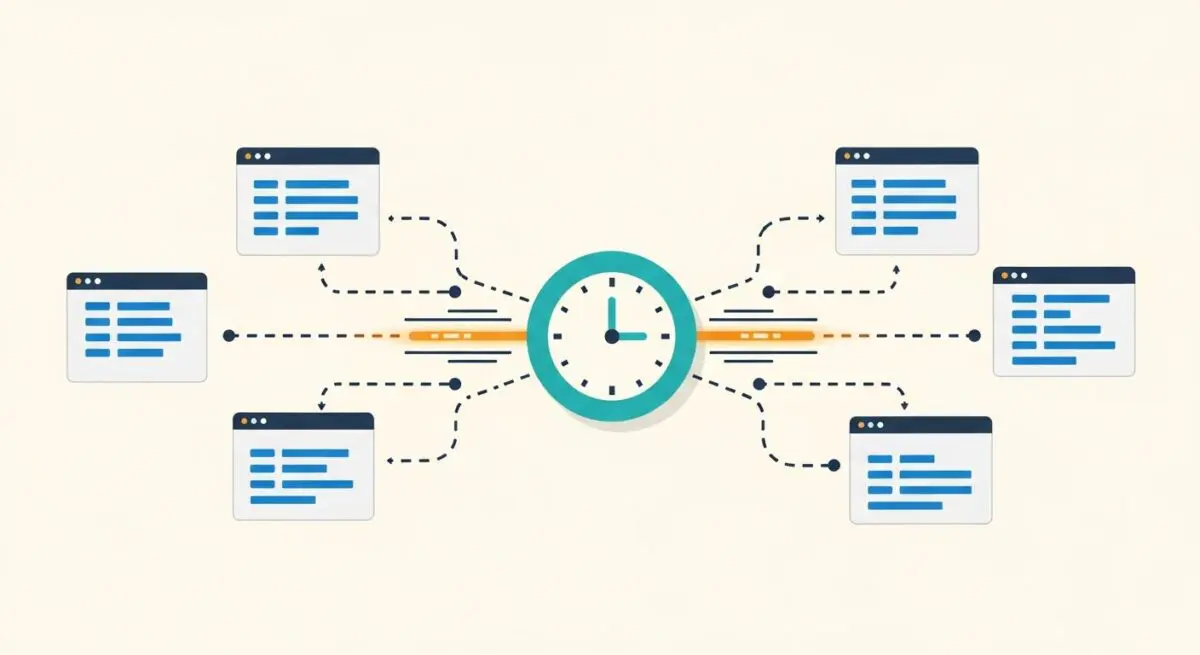
A Cron Job is a time-based job scheduler in Unix-like operating systems that enables users to schedule jobs (commands or shell scripts) to run periodically at fixed times, dates, or intervals. It operates via the cron daemon, a background process that constantly monitors the system time and executes tasks defined in a configuration file known as a crontab (cron table). Each entry in a crontab follows a specific five-field syntax representing minutes, hours, day of the month, month, and day of the week.
In the context of modern AI automations and web architecture, Cron Jobs are frequently abstracted into cloud-native services like Google Cloud Scheduler or AWS EventBridge. These tools allow engineers to trigger serverless functions, execute database cleanups, or initiate complex data scraping workflows without manual intervention. By providing a reliable heartbeat for digital operations, Cron Jobs ensure that high-frequency tasks are performed with mathematical precision.
The Real-World Analogy
Imagine a high-end commercial building with an automated irrigation system. Instead of a gardener manually turning on the water every morning, the system is programmed to activate at exactly 5:00 AM every Monday, Wednesday, and Friday. The Cron Job is the digital timer in this scenario; it does not care what the weather is or who is watching—it simply executes the instruction to “water the plants” at the precise moment it was told to do so, ensuring the landscape remains maintained without human oversight.
Why is Cron Job Critical for Autonomous Workflows and AI Content Ops?
For AI-driven content operations and programmatic SEO, Cron Jobs are the engine behind data freshness and architectural stability. They are essential for triggering stateless automation sequences where an AI model must process new data inputs at regular intervals. Without scheduled execution, tasks like sitemap regeneration, API-driven content refreshes, and sentiment analysis of real-time feeds would require constant human monitoring.
Furthermore, Cron Jobs facilitate efficient API payload management. By scheduling batch processing during off-peak hours, developers can optimize server resources and manage API rate limits effectively. This is particularly vital for GEO (Generative Engine Optimization) strategies, where large-scale data ingestion and vector database updates must occur systematically to maintain search relevance in an evolving AI landscape.
Best Practices & Implementation
- Implement Robust Logging: Always redirect output and error streams (stdout and stderr) to log files to facilitate debugging when a scheduled task fails silently.
- Use External Monitoring: Employ “dead man’s snitch” services or heartbeat monitors to alert the team if a Cron Job fails to execute within its expected window.
- Ensure Idempotency: Design scripts so that if they run multiple times or overlap, they do not cause data corruption or duplicate entries in your database.
- Manage Timezones Explicitly: Always configure Cron Jobs using UTC to avoid execution shifts during Daylight Saving Time transitions.
- Avoid Overlapping Executions: Use file locks or “flock” commands to prevent a new instance of a script from starting if the previous one is still running.
Common Mistakes to Avoid
One frequent error is assuming the environment variables available in a manual shell session are present during a Cron execution; Cron typically runs with a minimal environment, often leading to “command not found” errors. Another common mistake is failing to account for task duration; if a job scheduled every minute takes 90 seconds to complete, it can lead to resource exhaustion and race conditions. Finally, many organizations neglect to secure sensitive credentials, often hardcoding API keys directly into crontab files instead of using secure environment secret managers.
Conclusion
Cron Jobs remain the gold standard for temporal task scheduling, providing the necessary reliability for scaling AI-driven content pipelines and autonomous digital infrastructures.