Executive Summary
- Identity-Centric SecOps: The market has shifted from log-centric ingestion to identity-centric security operations, driven by major acquisitions and the need for precise attribution in compliance audits.
- Federated Intelligence: Modern SIEMs utilize the Open Cybersecurity Schema Framework (OCSF) to query data in-place, eliminating the ingestion tax while maintaining the 72-hour reporting windows required by new mandates.
- Autonomous Agent Orchestration: The transition from static playbooks to agentic workflows allows for real-time remediation, though it introduces new liabilities regarding probabilistic AI decision-making.
The Strategic Evolution of Compliance Infrastructure
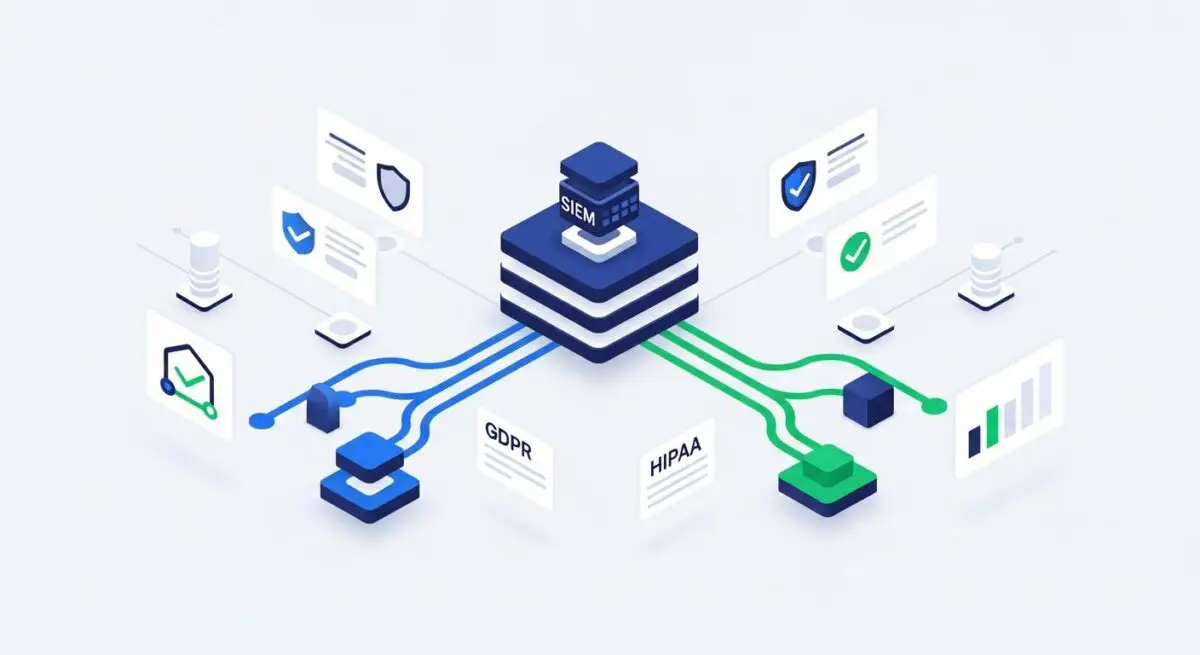
In today’s mature market reality, the role of Security Information and Event Management (SIEM) has evolved from a passive repository of logs into a proactive engine of corporate governance. For the modern enterprise, compliance with frameworks like GDPR and HIPAA is no longer a checkbox exercise but a high-stakes operational requirement. The transition toward platformization, led by giants like Microsoft and Palo Alto Networks, reflects a broader shift in how organizations value security data. We are seeing a move away from simple data collection toward a model where the depth of integration determines the strategic value of the security stack.
The economic drivers of this shift are clear. As organizations face increasingly stringent reporting windows, the ability to synthesize disparate data points into a coherent narrative is the difference between a routine audit and a catastrophic fine. The market has corrected from the speculative peaks of previous years, now rewarding platforms that offer de-risked AI integration and native integration across Extended Detection and Response (XDR) and Security Orchestration, Automation, and Response (SOAR) environments. This consolidation is not merely a trend; it is a structural response to the complexity of global data sovereignty.
Identity-Centric SecOps and the New Perimeter
The most significant technical pivot in recent months is the move toward Identity-Centric SecOps. Following major industry acquisitions, the focus has shifted from monitoring endpoints to monitoring the identities that traverse them. In a world where remote work and cloud-native architectures are the norm, the identity is the only consistent perimeter. For GDPR compliance, this means that tracking data access is no longer about which IP address accessed a file, but which specific user or autonomous agent initiated the request.
This shift is critical for maintaining the integrity of Subject Access Requests (SARs) and data deletion mandates. When a SIEM is built on an identity-centric foundation, it can map every action back to a verifiable entity. This level of granularity is essential for the audit-grade evidence generation required by modern regulators. By integrating identity logs with endpoint telemetry, organizations can create a high-fidelity map of data movement, ensuring that sensitive information remains within its designated geographic and jurisdictional boundaries.
Federated Intelligence and the OCSF Framework
One of the primary friction points in traditional SIEM deployments has been the ingestion tax—the high cost of moving and storing massive volumes of data for the sake of compliance. To solve this, the industry is moving toward Federated Intelligence. Utilizing the Open Cybersecurity Schema Framework (OCSF), modern SIEMs can now query data in-place across multi-cloud environments like AWS S3 or Azure Data Lake. This approach allows organizations to maintain a lean hot storage layer for immediate detection while keeping the vast majority of compliance data in cost-effective cold storage.
This federated model is particularly relevant for HIPAA compliance, where long-term data retention is mandatory but frequent access is rare. By querying data where it resides, enterprises avoid the latency and cost associated with monolithic data lakes. Furthermore, the implementation of Edge General Intelligence (EGI) allows for real-time inference at the network edge. This means that nearly three-quarters of enterprise data is processed before it even reaches the central SIEM, with the orchestration layer only receiving the high-level insights necessary for regulatory reporting.
A modern SIEM functions like a sophisticated central bank for data; it does not need to hold every physical coin in its central vault to manage the economy, but it must have an instantaneous, verifiable ledger of every transaction occurring across its entire network of branches.
The Productivity Paradox and the Model Auditor Shift
Despite the advancement of generative triage features, many organizations are experiencing a productivity paradox. While AI can reduce alert noise by over 80%, the time required to resolve complex incidents has remained stagnant. This is largely due to a specialized talent gap, as firms struggle to transition their staff from alert responders to model auditors. In a regulatory context, the human-in-the-loop requirement is more critical than ever. Regulators are increasingly skeptical of black box AI decisions, demanding that organizations explain the deterministic reasons behind autonomous containment actions.
This challenge is known as probabilistic liability. If an AI agent shuts down a production database based on a false-positive lateral movement alert, the CISO must be able to justify that action to both the board and the regulators. The shift from responding to alerts to auditing the models that generate them requires a new set of skills. Organizations that successfully bridge this gap are seeing significant operational ROI, allowing their senior engineers to reallocate their cognitive load toward proactive threat hunting rather than manual log review.
Navigating the HIPAA 2026 Overhaul and Global Mandates
The regulatory landscape has become significantly more demanding with the finalization of the HIPAA Security Rule updates. The shift from addressable to mandatory implementation specifications means that encryption and multi-factor authentication are now non-negotiable for any system accessing electronic protected health information (ePHI). Most critically, the new 72-hour security incident notification window has forced a redesign of incident response workflows. A SIEM can no longer be a passive observer; it must be an active participant in the remediation process.
Under the new EU AI Act, non-compliance risks are even more severe, with potential fines reaching up to 10% of global turnover. This has elevated SIEM selection from a technical decision to a boardroom priority. The ability to provide real-time, audit-grade evidence is now a competitive advantage. For service providers, offering Compliance-as-a-Service via a managed SIEM has become a powerful lever for increasing customer lifetime value, as clients seek long-term stability in an increasingly volatile regulatory environment.
Andres SEO Expert Analysis
From my perspective in the strategy room, the move toward platformization is the most significant de-risking event for the enterprise in the last decade. We are moving away from a fragmented ecosystem of best-of-breed tools toward integrated platforms that offer a unified view of risk. This is not just about technical efficiency; it is about capital allocation. By reducing the ingestion tax and leveraging federated search, companies can redirect millions of dollars from storage costs toward strategic initiatives that drive growth. The real winners in this landscape will be the firms that treat their security data as a strategic asset rather than a liability.
We must also recognize that the transition to agentic SOC workflows is inevitable. The scale of modern data is simply too large for human-only teams to manage. However, the moat for future-proof businesses will not be the AI tools themselves, but the governance frameworks that surround them. I advise my clients to focus on the auditability of their automated systems. If you cannot explain why your AI made a decision, you are not compliant, regardless of how fast your response time is. True resilience comes from the marriage of autonomous speed and human-led accountability.
Securing the Future of Enterprise Governance
The intersection of SIEM technology and regulatory compliance represents a fundamental shift in how businesses manage risk. By adopting identity-centric architectures, leveraging federated intelligence, and preparing for the shift to model auditing, organizations can transform their security operations from a cost center into a strategic pillar of trust. As the regulatory environment continues to tighten, the ability to demonstrate real-time control over data will be the ultimate differentiator for the global enterprise.
Navigating the intersection of generative search and operational efficiency requires more than just tools—it requires a roadmap. If you’re ready to evolve your strategy through specialized SEO, GEO, Adavanced Hosting Environments, or AI-driven automation, connect with Andres at Andres SEO Expert. Let’s build a future-proof foundation for your business together.”