Executive Summary
- SDRs function as the primary filter in the lead generation pipeline, utilizing MarTech stacks to qualify Top-of-Funnel (ToFu) prospects.
- The role is critical for optimizing Customer Acquisition Cost (CAC) by ensuring Account Executives focus only on high-intent opportunities.
- Integration with LLMs and CRM automation is transforming SDR workflows from manual outreach to data-driven programmatic engagement.
What is Sales Development Representative (SDR)?
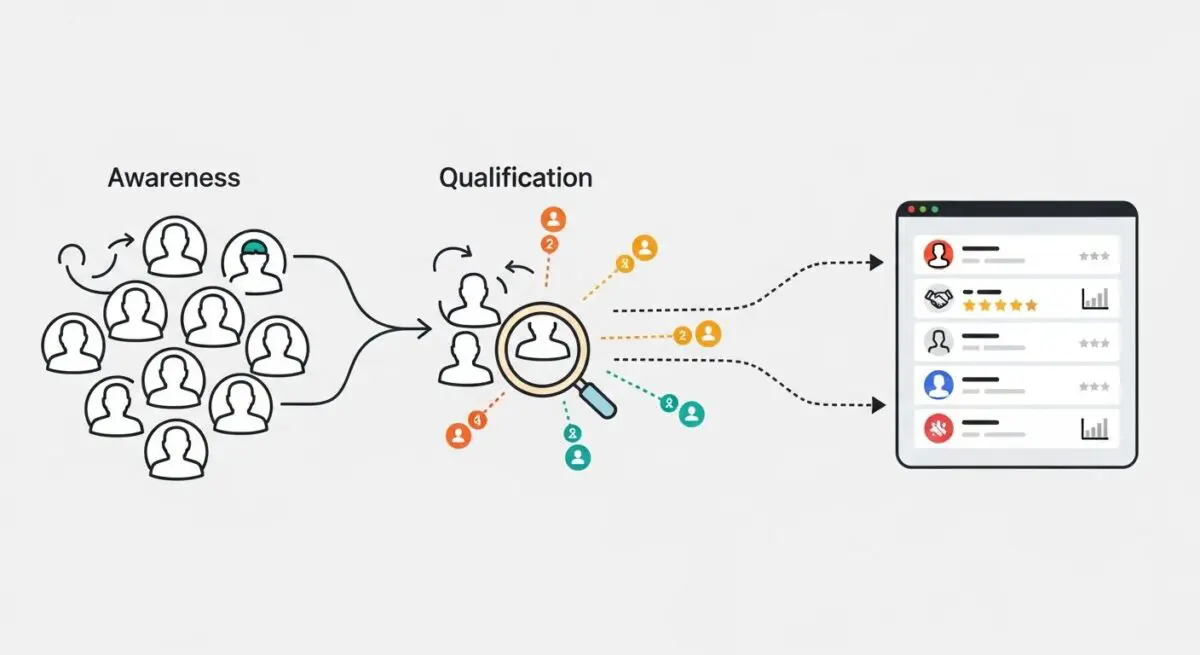
A Sales Development Representative (SDR) is a specialized B2B sales professional whose primary objective is to execute the initial stages of the sales funnel, specifically focusing on outbound prospecting and inbound lead qualification. Unlike traditional sales roles that manage the entire lifecycle of a deal, the SDR operates within a bifurcated sales model, serving as the critical link between marketing-generated interest and sales-closed revenue. In the modern MarTech ecosystem, the SDR role is heavily data-driven, utilizing sophisticated tools to identify, contact, and qualify potential customers before transitioning them to Account Executives (AEs) for closing.
Technically, the SDR functions as a human-in-the-loop component of a company’s lead scoring and distribution architecture. They leverage intent data, firmographic filters, and behavioral triggers to prioritize outreach. By focusing exclusively on the Top of the Funnel (ToFu) and Middle of the Funnel (MoFu), SDRs ensure that the sales pipeline remains populated with high-quality opportunities. This specialization allows for greater efficiency in the sales process, as it prevents high-cost closing resources from being diverted toward unqualified or low-intent prospects.
In the context of digital marketing and SEO, the SDR role is the ultimate validator of lead quality. While SEO and performance marketing drive traffic and conversions (MQLs), the SDR provides the qualitative feedback loop necessary to refine these strategies. They verify whether the traffic generated by specific keywords or campaigns actually aligns with the Ideal Customer Profile (ICP), providing granular data that can be used to optimize bidding strategies, content creation, and overall marketing spend.
The Real-World Analogy
To understand the role of a Sales Development Representative, imagine a high-precision manufacturing facility that produces aerospace components. In this environment, the marketing department acts as the raw material supplier, delivering large quantities of metal alloys to the factory. However, not every piece of metal is suitable for high-stress aerospace applications; some may have internal fractures or incorrect chemical compositions. The SDR is the Quality Control (QC) Inspector standing at the beginning of the assembly line. Their job is to rigorously test every incoming batch of material using specialized sensors and diagnostic tools. Only the materials that meet the exact specifications are passed forward to the master craftsmen (the Account Executives), who then forge the final product. Without the QC Inspector, the craftsmen would waste valuable time attempting to work with defective materials, leading to catastrophic failures and massive financial losses.
How Sales Development Representative (SDR) Impacts Marketing ROI & Data Attribution?
The strategic impact of an SDR team on Marketing ROI is primarily realized through the optimization of Customer Acquisition Cost (CAC) and the improvement of Lead-to-Opportunity conversion rates. In a standard B2B environment, marketing teams often struggle with attribution lag—the time between a lead’s first touchpoint and the eventual revenue realization. SDRs bridge this gap by providing immediate, human-verified data points that automated systems might miss. By qualifying leads based on BANT (Budget, Authority, Need, and Timeline) or similar frameworks, SDRs provide a Sales Qualified Lead (SQL) metric that is far more predictive of revenue than a simple Marketing Qualified Lead (MQL).
From a data attribution perspective, SDRs are essential for closing the loop between top-of-funnel activities and bottom-line results. When an SDR engages with a prospect, they capture qualitative data—such as specific pain points, current tech stacks, and organizational hurdles—that is then logged into the CRM. This data allows marketing directors to perform Closed-Loop Attribution, identifying which specific SEO clusters or programmatic ad sets are producing not just the most leads, but the most qualified leads. This level of insight is crucial for shifting from a volume-based marketing model to an Account-Based Marketing (ABM) or high-intent model.
Furthermore, the integration of SDR activities with Marketing Automation Platforms (MAP) and Large Language Models (LLMs) has introduced the concept of Programmatic Prospecting. Modern SDR teams use AI to personalize outreach at scale, analyzing vast datasets to determine the optimal time and channel for engagement. This technical synergy increases the Lead Velocity Rate, which measures the growth in qualified leads month-over-month. A high Lead Velocity Rate, managed by an efficient SDR team, is one of the strongest predictors of future revenue growth and long-term enterprise value.
Strategic Implementation & Best Practices
- Define a Rigorous Ideal Customer Profile (ICP): Successful SDR implementation begins with a technical definition of the ICP, including firmographic data (revenue, headcount), technographic data (current software usage), and intent signals. This ensures SDRs are not wasting cycles on low-probability accounts.
- Implement Multi-Channel Sequencing: Outreach should never be limited to a single medium. A technical best practice is to deploy automated, multi-step sequences that combine personalized emails, LinkedIn engagement, and strategic phone calls, all tracked via a Sales Engagement Platform (SEP) like Outreach or Salesloft.
- Establish a Seamless SDR-to-AE Handoff: The transition of a qualified lead must be governed by a strict Service Level Agreement (SLA). This includes automated calendar scheduling, comprehensive discovery notes in the CRM, and a warm introduction to ensure no loss of momentum or data integrity.
- Leverage Intent Data and Predictive Analytics: Integrate third-party intent data providers (e.g., 6sense, Bombora) directly into the SDR workflow. This allows representatives to prioritize prospects who are actively researching relevant solutions, significantly increasing the probability of a successful engagement.
- Continuous Feedback Loops with Marketing: SDRs should participate in weekly Lead Quality Reviews with the marketing team. By analyzing why certain leads were disqualified, marketing can adjust their SEO targeting and ad copy to improve the quality of the incoming funnel.
Common Pitfalls & Strategic Mistakes
One of the most frequent mistakes in SDR management is the Volume over Value trap. Organizations often incentivize SDRs based solely on the number of activities (calls made, emails sent) rather than the quality of the opportunities created. This leads to burnout and brand damage, as prospects are bombarded with generic, low-value outreach. A more technical approach is to measure Pipeline Contribution Value, which weighs leads based on their potential deal size and strategic fit.
Another significant pitfall is the existence of data silos between the SDR team and the rest of the organization. If SDR notes and engagement history are not correctly mapped to CRM fields, the marketing team cannot optimize their campaigns, and the AE enters the closing call without critical context. This lack of data continuity results in a fragmented customer experience and lower win rates. Finally, failing to adapt to AI-driven prospecting can leave an SDR team at a competitive disadvantage. Organizations must balance human intuition with AI efficiency, using LLMs for research and drafting while maintaining human oversight for high-stakes relationship building.
Conclusion
The Sales Development Representative (SDR) is a cornerstone of the modern B2B revenue engine, providing the essential human-led qualification needed to scale growth efficiently. By integrating SDR operations with advanced MarTech stacks and data-driven strategies, enterprises can significantly lower CAC and maximize the ROI of their marketing investments.