Executive Summary
- MQLs are prospects identified through algorithmic lead scoring based on behavioral intent and firmographic alignment.
- The MQL stage serves as a critical filter in the demand generation funnel to optimize Sales Development Representative (SDR) resources.
- Modern MQL frameworks integrate AI-driven predictive modeling to refine lead quality and improve conversion rates from marketing to sales.
What is Marketing Qualified Lead (MQL)?
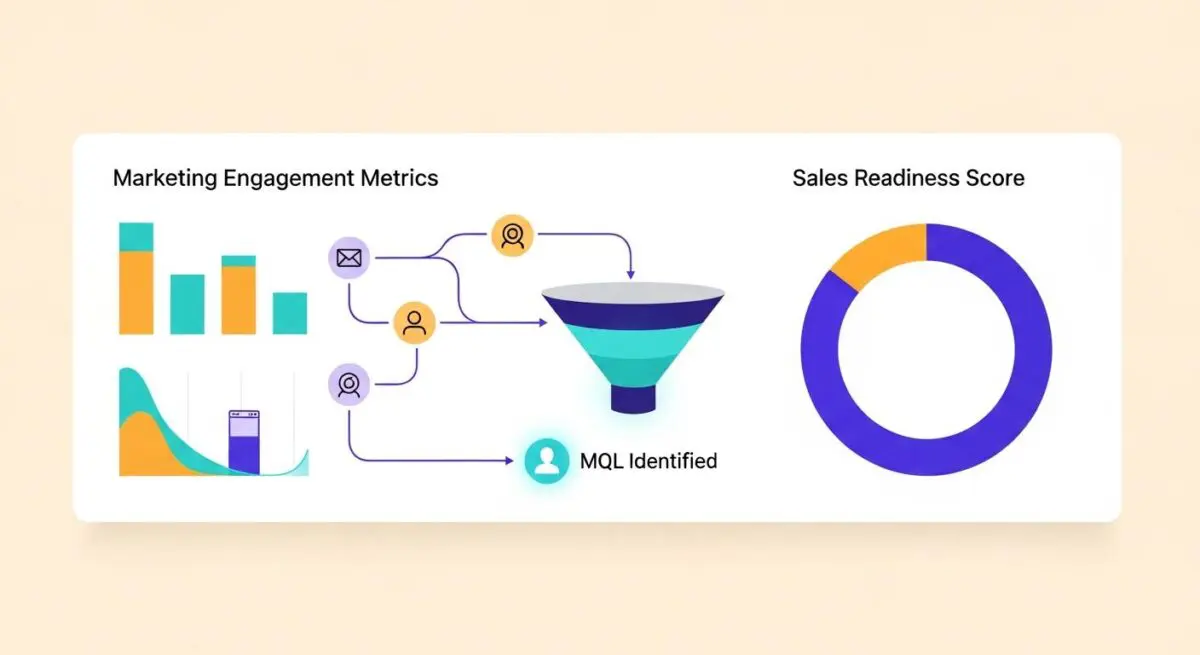
A Marketing Qualified Lead (MQL) is a prospective customer who has been vetted by the marketing department based on specific pre-defined criteria, indicating a higher likelihood of conversion compared to other leads. Within a sophisticated MarTech stack, an MQL is not merely a contact record; it is a data-driven designation triggered when a user crosses a specific threshold in a lead scoring model.
This model typically aggregates explicit data, such as job title, industry, and company size, with implicit behavioral data, such as whitepaper downloads, repeated visits to high-value pricing pages, or engagement with specific email sequences. By isolating these individuals, marketing teams can prioritize their efforts and ensure that only high-intent prospects are handed off to the sales organization.
In the context of modern Search Engine Optimization (SEO) and Generative Engine Optimization (GEO), the MQL serves as a primary KPI for content efficacy. It bridges the gap between top-of-funnel (ToFu) awareness and bottom-of-funnel (BoFu) conversion.
From a technical perspective, the identification of an MQL often involves complex API integrations between a Marketing Automation Platform (MAP) like Marketo or HubSpot and a Customer Relationship Management (CRM) system like Salesforce.
These systems utilize webhooks and tracking pixels to monitor user journeys across multiple touchpoints, applying weighted scores to various actions to determine when a lead has reached the “qualified” status. This process ensures that the sales pipeline is populated with prospects who have demonstrated a clear interest in the brand’s value proposition.
The Real-World Analogy
To understand the Marketing Qualified Lead (MQL) in a non-technical context, consider the operations of a high-end, invitation-only art gallery. Many people may walk past the gallery and look through the window; these are your general website visitors or “raw leads.” Some might even walk inside to browse the collection without any intention of buying; these are “engaged leads.” However, a visitor becomes an MQL when they perform a specific set of actions that signal serious intent: they ask for a catalog of a specific artist, provide their contact information to be notified of future exhibitions, and spend a significant amount of time examining the price list.
The gallery’s front-of-house staff (Marketing) identifies this person as a serious prospect based on these behaviors and the fact that they fit the profile of a collector. Only then do they introduce the visitor to the gallery director (Sales) to discuss a private acquisition. The MQL designation ensures the director’s time is spent with someone ready to talk business, rather than a casual tourist.
How Marketing Qualified Lead (MQL) Impacts Marketing ROI & Data Attribution?
The strategic identification of MQLs has a profound impact on Marketing Return on Investment (ROI) by significantly reducing the Customer Acquisition Cost (CAC). By implementing a rigorous MQL framework, organizations prevent the “sales friction” that occurs when sales teams are forced to chase low-quality leads. This efficiency allows Sales Development Representatives (SDRs) to focus their high-touch outreach on prospects with a statistically higher probability of closing, thereby increasing the overall conversion rate of the sales pipeline. Furthermore, the MQL stage provides a granular data point for multi-touch attribution models. By analyzing which channels—be it organic search, paid social, or programmatic display—are most effective at generating MQLs, marketers can reallocate budgets toward the highest-performing tactics.
Data integrity is paramount when defining MQLs. Inaccurate lead scoring or fragmented data silos can lead to “MQL inflation,” where the quantity of leads increases while quality diminishes. This misalignment often results in a breakdown of the “Smarketing” (Sales and Marketing alignment) relationship. To mitigate this, advanced organizations utilize closed-loop reporting, where sales feedback on MQL quality is fed back into the marketing automation engine. This creates a recursive loop that refines lead scoring algorithms over time. In the era of AI-driven marketing, LLMs can now be used to analyze the qualitative data within MQL interactions—such as the specific questions asked in a contact form—to provide even deeper insights into lead intent, further sharpening the accuracy of attribution and ROI calculations.
Strategic Implementation & Best Practices
- Develop a Multi-Dimensional Lead Scoring Matrix: Implement a scoring system that weighs both demographic fit (ICP) and behavioral intent. For instance, a C-level executive downloading a technical case study should be weighted more heavily than an entry-level employee performing the same action.
- Establish a Formal Service Level Agreement (SLA): Define a clear contract between marketing and sales that outlines exactly what constitutes an MQL and the expected follow-up time for the sales team. This ensures accountability and prevents lead decay.
- Utilize Negative Scoring: To maintain data hygiene, implement negative scoring for behaviors that indicate a lack of commercial intent, such as visits to the “Careers” page, use of a competitor’s IP address, or the use of personal email domains (e.g., @gmail.com) in a B2B context.
- Integrate Real-Time Intent Data: Leverage third-party intent data providers (e.g., 6sense or Bombora) to supplement first-party data. This allows you to identify MQLs who are researching solutions across the broader web, even before they engage deeply with your own owned media.
- Continuous Algorithmic Refinement: Regularly audit your MQL criteria using historical conversion data. Use machine learning models to identify which behavioral patterns most frequently lead to closed-won deals and adjust your scoring weights accordingly.
Common Pitfalls & Strategic Mistakes
One of the most frequent errors in enterprise marketing is the reliance on static, “set-it-and-forget-it” lead scoring. Market dynamics and buyer behaviors shift rapidly; a scoring model that worked two years ago may now be capturing the wrong signals, leading to inefficient budget allocation. Another common pitfall is the over-prioritization of MQL volume over MQL velocity. Marketing teams often focus on hitting a raw number of MQLs to satisfy quarterly goals, ignoring how long it takes for those leads to move through the funnel. This can lead to a bloated pipeline of stagnant leads that never convert to revenue.
Finally, many organizations suffer from a lack of data synchronization between their MAP and CRM. If the marketing team is qualifying leads based on data that the sales team cannot see or verify, trust in the MQL designation erodes. This siloed approach prevents a holistic view of the customer journey and makes it impossible to accurately calculate the lifetime value (LTV) associated with specific marketing entry points. In the age of AI, failing to integrate these data streams limits the ability of predictive analytics to accurately forecast future revenue based on current MQL trends.
Conclusion
The Marketing Qualified Lead (MQL) remains a cornerstone of data-driven demand generation, acting as the primary filter for sales efficiency and marketing accountability. By leveraging advanced automation and continuous data refinement, organizations can ensure their MQL framework drives scalable, programmatic growth in an increasingly competitive digital landscape.